Jupiter’s Gravity May Explain 4.5-Billion-Year-Old Meteorite Mystery
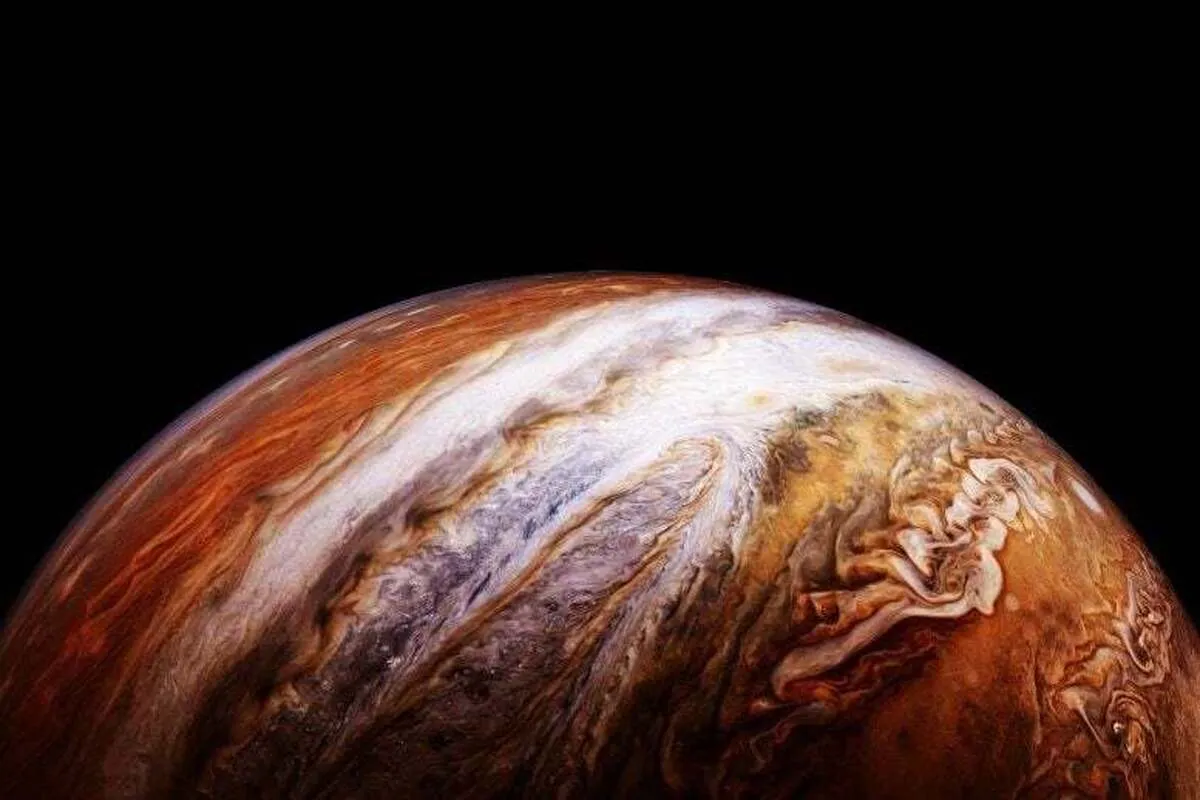
New research from Rice University reveals that Jupiter played a powerful role in shaping the early solar system. As the giant planet formed, it dramatically altered the structure of the surrounding disk of gas and dust, carving out rings and gaps that may finally explain a mystery that has puzzled scientists for decades: why many primitive meteorites appeared millions of years after the first solid materials. The study, published in Science Advances, combined advanced hydrodynamic models of Jupiter’s growth with simulations of dust behavior and planet formation.
Using high-resolution computer models, planetary scientists André Izidoro and Baibhav Srivastava discovered that Jupiter’s rapid early development disrupted the young solar system’s disk. Its immense gravitational pull sent waves through the surrounding gas and dust, creating “cosmic traffic jams” that stopped tiny particles from falling into the sun. Instead, these particles gathered into thick, stable rings where they could merge into planetesimals, the rocky precursors of planets.
The researchers found an unexpected twist: the planetesimals that formed in these dense regions were not part of the solar system’s original generation of building blocks. They formed later, representing a second wave of planetary material. Their emergence coincides with the formation of chondrites, a group of stony meteorites that carry valuable chemical and chronological evidence from the solar system’s earliest days.
“Chondrites are like time capsules from the dawn of the solar system,” said Izidoro, assistant professor of Earth, environmental, and planetary sciences at Rice. “They have fallen to Earth over billions of years, where scientists collect and study them to unlock clues about our cosmic origins. The mystery has always been: Why did some of these meteorites form so late, 2 to 3 million years after the first solids? Our results show that Jupiter itself created the conditions for their delayed birth.”
Chondrites are especially significant because they are some of the most primitive materials available to science. Unlike meteorites from the first generation of building blocks — which melted, differentiated, and lost their original character — chondrites preserve pristine solar system dust and tiny molten droplets called chondrules. Their late formation has puzzled scientists for decades.
“Our model ties together two things that didn’t seem to fit before — the isotopic fingerprints in meteorites, which come in two flavors, and the dynamics of planet formation,” said Srivastava, a graduate student working in Izidoro’s lab. “Jupiter grew early, opened a gap in the gas disk, and that process protected the separation between inner and outer solar system material, preserving their distinct isotopic signatures. It also created new regions where planetesimals could form much later.”
The study also helps explain another solar system mystery: why Earth, Venus and Mars are clustered around 1 astronomical unit from the sun rather than spiraling inward as happens in many extrasolar planetary systems. Jupiter cut off the flow of gas material toward the inner solar system, suppressing the inward migration of young planets. Instead of plunging toward the sun, these growing worlds remained trapped in the terrestrial region, where Earth and its neighbors eventually formed.
“Jupiter didn’t just become the biggest planet — it set the architecture for the whole inner solar system,” Izidoro said. “Without it, we might not have Earth as we know it.”
The findings are consistent with striking ring-and-gap structures astronomers now observe in young star systems with the Atacama Large Millimeter/submillimeter Array (ALMA) telescope, the most complex astronomical observatory ever built on Earth and located in northern Chile.
“Looking at those young disks, we see the beginning of giant planets forming and reshaping their birth environment,” Izidoro said. “Our own solar system was no different. Jupiter’s early growth left a signature we can still read today, locked inside meteorites that fall to Earth.”
4155/v