Iran is pulling the trigger; is it time for “armed negotiations”?
In recent months, the phrase “If negotiations with the United States take place this time, it will definitely be an armed negotiation” has been uttered by Saeed Khatibzadeh, the Deputy Minister of Foreign Affairs of Iran, at least 3 times, including in interviews with the Phoenix and Frankfurter Allgemeine news agencies.
Once, in a group of journalists and on the sidelines of the international conference “International Law Under Aggression: Aggression and Defense” held on November 15; in explaining the phrase “We will have all fingers on the trigger”; He had said: “In a situation where the other side has used all its military weapons against other countries and organized its resources in the form of a threatening arrangement, it is impossible to speak of an impartial negotiation. Therefore, if one day a negotiation with the United States takes place within the framework of the announced conditions, it will definitely be an armed negotiation; a negotiation in which Iran has no trust in the other side and is ready to take effective measures against possible deceptions.”
At that point, the word “armed” was interpreted as “distrustful and suspicious.” However, today, with the rapid progress of developments, including the US naval expedition to the region and the pressure on Iran to submit to Washington’s nuclear and missile conditions, it is much easier to decipher the keyword “armed negotiations,” which was previously conveyed to the media under the veneer of diplomacy.
Negotiations under the umbrella of deterrence
Now, Seyyed Abbas Araqchi, the head of the diplomatic apparatus, has put aside considerations and, in response to US President Donald Trump’s threatening tweet that “time is running out; make the deal” and his recent claim that “I intend to negotiate with Iran,” says: Our armed forces are ready with their finger on the trigger.
In this way, Araqchi once again reminded the other side that in Iran, the field and diplomacy are complementary; a warning that was immediately supplemented by Kazem Gharibabadi, the Deputy Minister of Legal and International Affairs of the Foreign Ministry, with this statement: Our first priority is full readiness for defense. Even if the conditions for negotiations are prepared, given the history of American deception, Tehran will maintain its full readiness for defense.
In the new context, Khatibzadeh’s quote takes on a different meaning.
In this context, “armed negotiations” are no longer simply a diplomatic metaphor; It is a precise description of a real scene in which US aircraft carriers are lined up in the waters of the region and the US president speaks of a “willingness to talk” while threatening a “much worse attack.” This is where Washington’s alleged diplomacy collides with its military reality.
Iran, however, has already changed the rules of the game. When Gharibabadi says that “even any limited US attack will be met with a befitting response” and clarifies that “Tehran’s priority is not to talk with the US but to be 200 percent ready to defend the country,” he is in fact elevating Khatibzadeh’s same proposition from the theoretical level to the level of operational strategy: if there is to be a conversation, it will be under the umbrella of deterrence, not instead of it.
The region’s negative response to the diplomacy of intimidation
This is where Trump’s narrative project collapses. The US president is trying to portray himself as a “patient negotiator” who is forced to apply pressure in the face of “Iranian stubbornness.” But at the same time, when he says, referring to last summer’s attacks on Iran’s nuclear facilities, “the next attack will be much worse,” he is effectively admitting that what he has put on the table is not an agreement, but a threat.
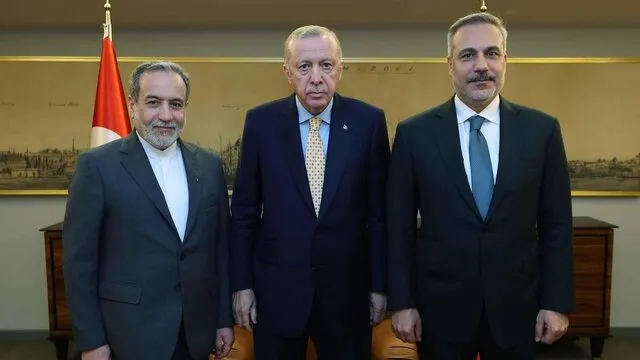
Meanwhile, Turkey’s entry as a potential mediator is a sign of regional players’ concern about the dangerous path Washington has taken. Turkey’s offer of mediation, which was raised today in a phone call between President Recep Tayyip Erdogan and his Iranian counterpart, Masoud Pezizkian, is in fact an attempt to remove the Iranian case from the logic of threats and return it to the realm of real diplomacy.
Turkey has warned since the beginning of the escalation of tensions between Tehran and Washington that the path of threats not only does not bring about an agreement, but also leads the region towards an explosion.
At the same time, in a joint press conference held in Istanbul today, Friday, February 10, Araghchi pointed to this regional understanding and warned that “the security of each country in the region is the security of the entire region, and insecurity and war will mean war in the entire region.”
Thus, Washington’s insistence on threat-based diplomacy is not just a bilateral pressure against Iran; it is also a game with the security of the entire Middle East.
Field and diplomacy, two sides of the same coin
In contrast to the model of “attempting to impose an agreement through intimidation” adopted by the White House, Iran, which sees its neighbors’ efforts to quell the crisis, has chosen the option of “negotiations under the umbrella of deterrence.”
This means that as long as Trump continues to send ships and at the same time talk about “dialogue,” Tehran will also stand on the same doctrine of “armed negotiations.” A doctrine whose essence can be summarized in this sentence: "We do not and have not wanted war, but we will give a painful response to any military action."
Today, in response to the goodwill of his Turkish counterpart, Hakan Fidan, who seeks to define "Tehran-Washington relations on a new basis" and considers the resumption of talks important, Araqchi emphasized: