Iranian Student, Colleagues Manufacture Pocket-Sized Hand-Launched Foldable Drone
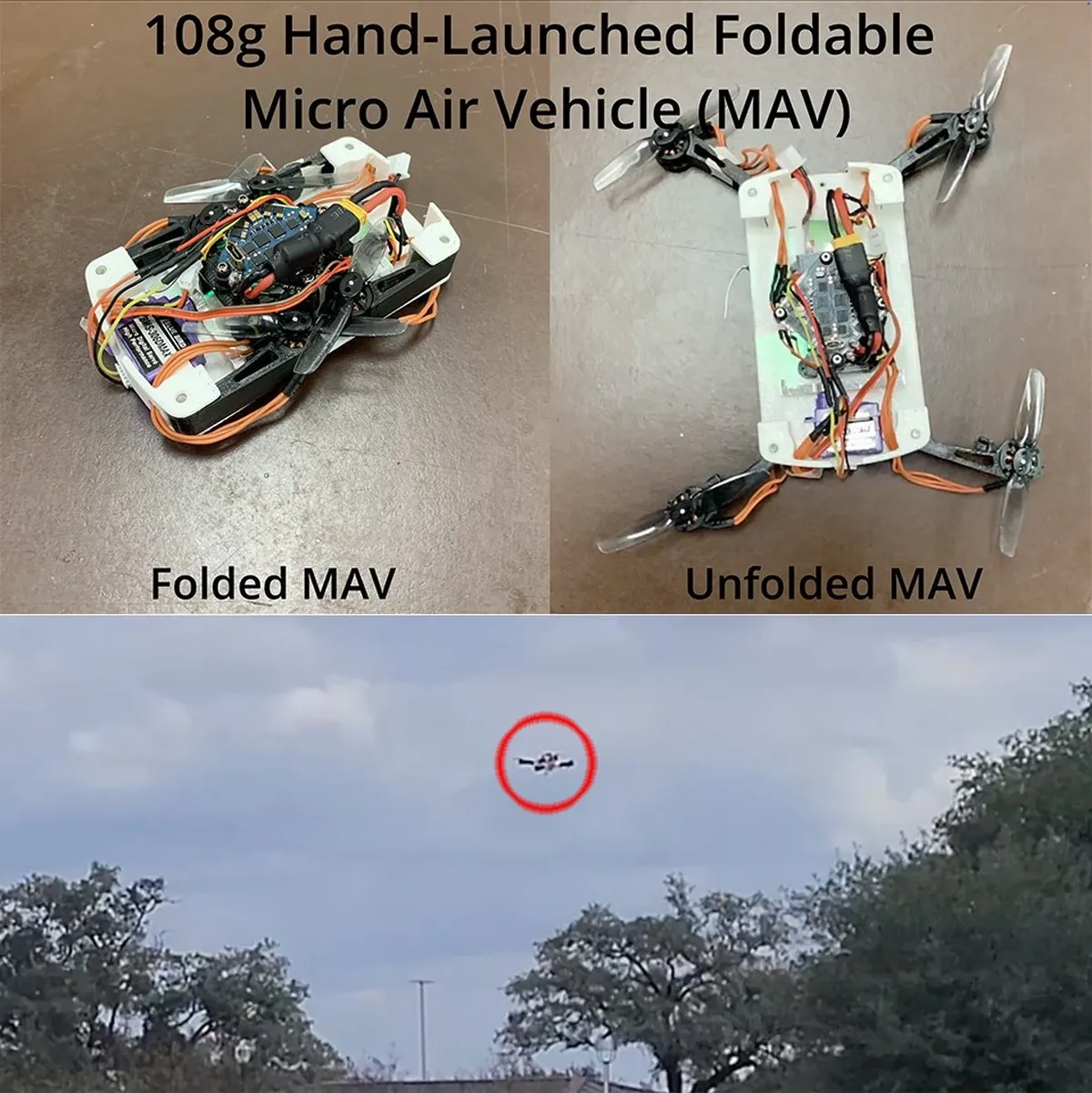
This small drone can fold down to the size of a smartphone and then unfold in midair to stabilize itself within seconds.
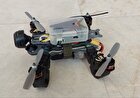
The MAV’s standout feature is its compact design. Weighing less than a can of soda, it folds into a sleek rectangular shape, small enough to slip into a pocket or bag.
Once thrown into the air, the arms extend outward automatically, lock into place, and the drone steadies itself. Even if it spins at extreme speeds of up to 2,500 degrees per second during launch, it can quickly regain balance and hover.
The key to this drone’s ability to stabilize is a sophisticated feedback controller. This onboard system allows the MAV to recover from rapid spins and orient itself correctly after being tossed.
The AVFL team carried out multiple flight tests to demonstrate this. They launched the MAV in different ways, from gentle tosses to forceful throws. In every case, the sensors and algorithms onboard read the drone’s orientation and adjusted the propellers to settle it into a smooth hover.
Whether tossed softly or thrown with force, the drone’s sensors and algorithms quickly detect its position and adjust the propellers to stabilize it.
This ability to recover instantly gives the MAV a major advantage. Many drones require careful handling or controlled takeoff, but this one is ready to fly the moment it leaves your hand.
Behind the sleek folding arms lies a thoughtful engineering effort. The Texas A&M team, including undergraduates Hunter Denton and Farid Saemi, aimed to balance size, weight, and performance in a single design.
The foldable propeller arms are the centerpiece of this innovation. When tucked in, they reduce the drone’s footprint, making it easier to carry. When extended, they provide enough lift for stable hovering. This combination makes the MAV strong in the air while remaining extremely portable.
The research team relied on advanced flight dynamics modeling to get the MAV working reliably. They built a six degrees of freedom (6DOF) model, which simulates how the drone behaves in 3D space.
This model accounted for forces such as lift, drag, and torque. To ensure accuracy, they validated the model with real-world flight data captured using motion tracking systems.
By comparing the model with actual performance, the team refined the design, improving the MAV’s ability to handle unpredictable launches. “This is what sets the MAV apart – it’s not just a prototype but a tested system ready for use,” said the researchers.
The potential uses for this pocket-sized MAV extend far beyond the lab. Its small form factor and quick deployment make it valuable in urgent situations.
In emergency response, first responders could carry several MAVs and launch them into disaster zones to assess damage or locate survivors in areas too dangerous to enter. The ability to throw a drone into the air and have it instantly stabilize saves critical time.
The military could also adopt the MAV for reconnaissance missions. Its portability and rugged design would allow soldiers to scout harsh environments without carrying bulky equipment.
Civilian applications are also promising. The drone could be used for aerial photography, building inspections, or exploring hard-to-reach spots such as rooftops and tall structures. With its easy handling, even casual users could operate it without technical training.
As the Texas A&M team demonstrated, engineering at a miniature scale does not mean sacrificing power or reliability.
4155/v