Hidden Heat Found on Uranus after 40 Years of Mystery
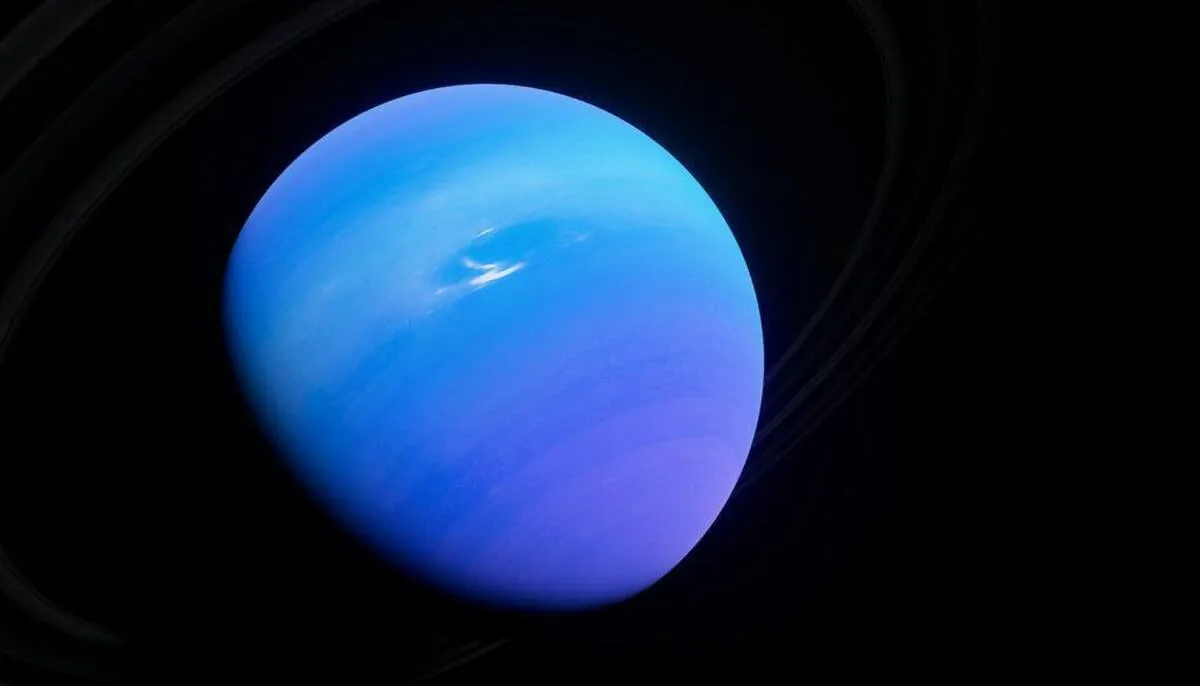
Warm-hearted giants: Jupiter, Saturn, and Neptune all give off more energy than they receive from the Sun, showing that their interiors are still surprisingly warm, the journal Geophysical Research Letters reported.
A chilly surprise: When NASA’s Voyager 2 flew past Uranus in 1986, it found the planet much colder than expected, throwing long-held ideas about planetary formation and evolution into question.
A warmer twist: By combining advanced computer models with a fresh analysis of decades-old data, scientists now think Uranus may actually be warmer than we once believed.
For centuries, Uranus was mistaken for a faraway star. It was only in the late 1700s that astronomers officially recognized it as a planet. Even now, this blue, ringed giant continues to surprise researchers, and new findings from NASA are beginning to reveal more about its puzzling nature.
Among the planets in our solar system, Uranus stands out for its unusual behavior. The planet rotates on its side, so each pole points toward the Sun for an uninterrupted 42-year “summer.” It also spins in the opposite direction from most planets, sharing this trait only with Venus. When NASA’s Voyager 2 spacecraft made its historic flyby in 1986, the data showed that Uranus was far colder inside than scientists had expected. This unexpected chill forced experts to rethink long-standing ideas about how planets form and develop.
“Since Voyager 2’s flyby, everybody has said Uranus has no internal heat,” said Amy Simon, a planetary scientist at NASA’s Goddard Space Flight Center in Greenbelt, Maryland. “But it’s been really hard to explain why that is, especially when compared with the other giant planets.”
These Uranus projections came from only one up-close measurement of the planet’s emitted heat made by Voyager 2: “Everything hinges on that one data point,” said Simon. “That is part of the problem.”
Now, using an advanced computer modeling technique and revisiting decades of data, Simon and a team of scientists have found that Uranus does, in fact, generate some heat, as they reported recently in the Monthly Notices of the Royal Astronomical Society journal.
A planet’s internal heat can be calculated by comparing the amount of energy it receives from the Sun to the amount it of energy it releases into space in the form of reflected light and emitted heat. The solar system’s other giant planets — Saturn, Jupiter, and Neptune — emit more heat than they receive, which means the extra heat is coming from inside, much of it left over from the high-energy processes that formed the planets 4.5 billion years ago. The amount of heat a planet exudes could be an indication of its age: the less heat released relative to the heat absorbed from the Sun, the older the planet is.
Uranus stood out from the other planets because it appeared to give off as much heat as it received, implying it had none of its own. This puzzled scientists. Some hypothesized that perhaps the planet is much older than all the others and has cooled off completely. Others proposed that a giant collision — the same one that may have knocked the planet on its side — blasted out all of Uranus’ heat. But none of these hypotheses satisfied scientists, motivating them to solve Uranus’ cold case.
“We thought, ‘Could it really be that there is no internal heat at Uranus?’” said Patrick Irwin, the paper’s lead author and professor of planetary physics at the University of Oxford in England. “We did many calculations to see how much sunshine is reflected by Uranus, and we realized that it is actually more reflective than people had estimated.”
The researchers set out to determine Uranus’ full energy budget: how much energy it receives from the Sun compared to how much it reflects as sunlight and how much it emits as heat. To do this, they needed to estimate the total amount of light reflected from the planet at all angles. “You need to see the light that’s scattered off to the sides, not just coming straight back at you,” Simon said.
To get the most accurate estimate of Uranus’ energy budget yet, Oxford researchers developed a computer model that brought together everything known about Uranus’ atmosphere from decades of observations from ground- and space-based telescopes, including NASA’s Hubble Space Telescope and NASA’s Infrared Telescope Facility in Hawaii. The model included information about the planet’s hazes, clouds, and seasonal changes, all of which affect how sunlight is reflected and how heat escapes.
The researchers found that Uranus releases about 15% more energy than it receives from the Sun, a figure that is similar to another recent estimate from a separate study funded in part by NASA. These studies suggest Uranus it has its own heat, though still far less than its neighbor Neptune, which emits more than twice the energy it receives.
“Now we have to understand what that remnant amount of heat at Uranus means, as well as get better measurements of it,” Simon said.
Unraveling Uranus’ past is useful not only for mapping the timeline of when solar system planets formed and migrated to their current orbits, but it also helps scientists better understand many of the planets discovered outside the solar system, called exoplanets, a majority of which are the same size as Uranus.
4155/v