Hidden Heat Source on Uranus Changes What We Know about Planets
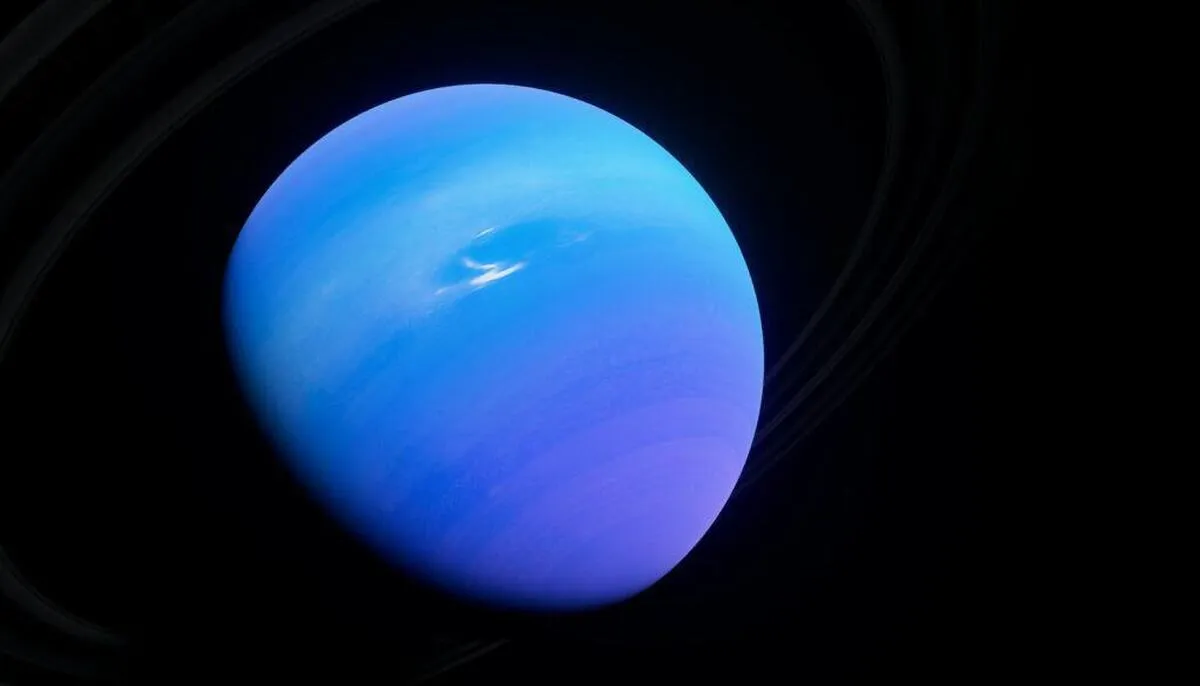
Uranus isn’t as cold as it seems — scientists found it’s still leaking ancient heat. The finding was published in Geophysical Research Letters, a top journal publication by the American Geophysical Union.
Scientists have discovered that Uranus gives off more heat than it takes in from the Sun, revealing that the planet still holds onto internal heat left over from its formation.
This breakthrough solves a decades-old mystery and could play a major role in shaping NASA’s upcoming mission to explore Uranus.
The methods used in the study could also help scientists learn more about other gas giants and offer fresh insights into the long-term evolution of our solar system, including potential impacts on Earth.
A new study from the University of Houston, conducted in partnership with planetary scientists around the world, has revealed that Uranus does, in fact, generate its own internal heat. This breakthrough not only enhances future planning for NASA missions, it also offers valuable insight into how planetary systems work, including those processes that impact Earth’s atmosphere and climate.
The findings help solve a long-standing puzzle about Uranus. When NASA’s Voyager 2 spacecraft flew by the planet in 1986, it found no strong evidence of internal heat, which challenged scientists’ existing theories about how large planets form and evolve.
Now, drawing on decades of data from spacecraft and advanced computer modeling, researchers have discovered that Uranus emits more heat than it absorbs from the Sun. According to lead author Xinyue Wang, a former doctoral student in the University of Houston’s Department of Earth and Atmospheric Sciences, this difference confirms the presence of internal heat.
“This means it’s still slowly losing leftover heat from its early history, a key piece of the puzzle that helps us understand its origins and how it has changed over time,” she explained.
The discovery is consistent with an independent study conducted by a research group led by Professor Patrick Irwin at the University of Oxford.
However, Uranus’s internal heat is weaker than its other giant counterparts in the solar system, emitting about 12.5% more heat than it absorbs via sunlight. This is lower compared to fluxes of upwards of 100% measured for Jupiter, Saturn and Neptune, said Xun Jiang, co-author and professor in the Department of Earth and Atmospheric Sciences.
“From a scientific perspective, this study helps us better understand Uranus and other giant planets. For future space exploration, I think it strengthens the case for a mission to Uranus.”
Xinyue Wang, UH’s Department of Earth and Atmospheric Sciences
It’s uncertain why this happened, but researchers said Uranus may have a different interior structure or evolutionary history compared to the other giant planets.
Another notable takeaway from the study was that Uranus’s energy levels also change with its long seasons, which last about 20 years. These seasonal changes are likely caused by the planet’s off-center orbit and tilted spin, Wang said.
Liming Li, co-author and professor in UH’s Department of Physics, said this study could improve planning for NASA’s flagship mission to orbit and probe Uranus, an initiative the National Academies of Sciences, Engineering and Medicine classified as its highest priority for the 2023-32 decade.
“From a scientific perspective, this study helps us better understand Uranus and other giant planets,” Wang said. “For future space exploration, I think it strengthens the case for a mission to Uranus.”
Additionally, the team’s methodology provides testable theories and models that could also be applied to explore radiant energy of other planets within and beyond our solar system, Li said. It could even impact techno logy innovation and climate understanding on Earth.
“By uncovering how Uranus stores and loses heat, we gain valuable insights into the fundamental processes that shape planetary atmospheres, weather systems, and climate systems,” Li said. “These findings help broaden our perspective on Earth’s atmospheric system and the challenges of climate change.”
4155/v


















