NASA’s Hubble Spots Blinding Explosion in Distant Spiral Galaxy
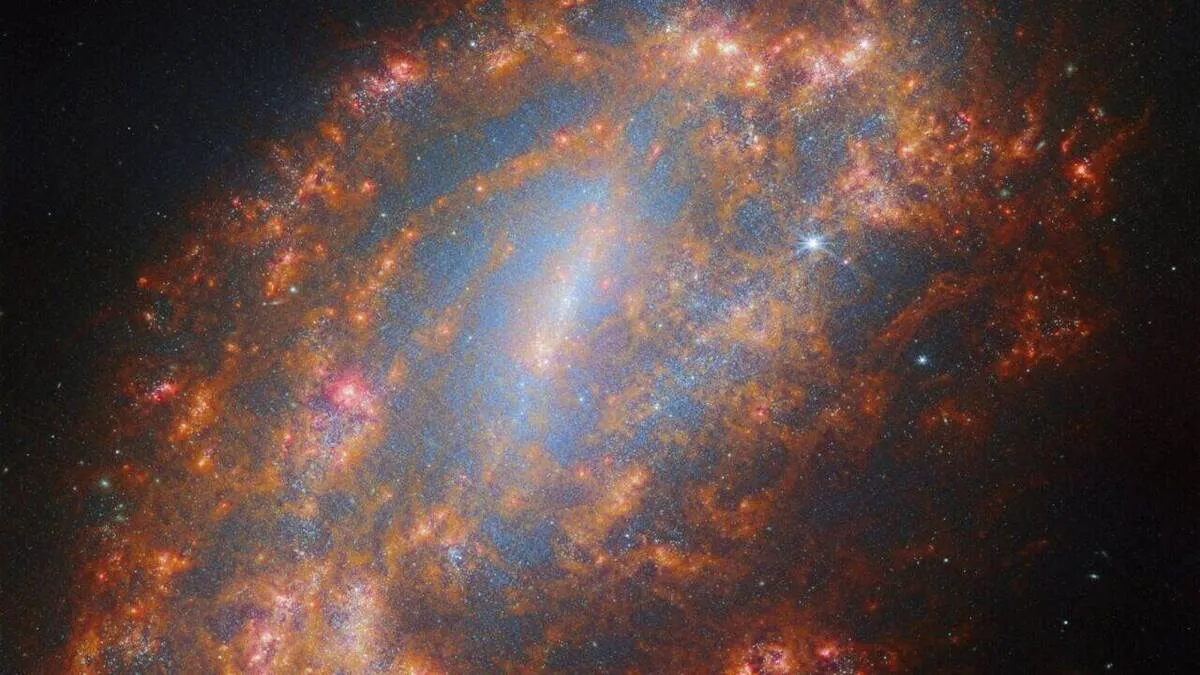
In this striking Hubble image, the spiral galaxy NGC 3285B gleams from 137 million light-years away in the vast Hydra constellation, the SciTechDaily reported.
But it’s not just the galaxy’s elegant swirl that’s capturing attention — a bright dot on its edge marks the violent death of a star: a Type Ia supernova from 2023. This stellar explosion, now frozen in light, is helping astronomers refine how we measure distances across the universe.
The featured galaxy in this Hubble Space Telescope image is NGC 3285B, a graceful spiral located roughly 137 million light-years from Earth in the constellation Hydra (The Water Snake). Hydra holds the distinction of being the largest of all 88 constellations in the night sky. It also stretches farther than any other, spanning 100 degrees from end to end. To put that in perspective, it would take the width of nearly 200 full Moons lined up in a row to cover the same distance across the sky.
NGC 3285B belongs to the Hydra I cluster, one of the most massive collections of galaxies in our local cosmic neighborhood. Galaxy clusters like this one are vast assemblies of hundreds or even thousands of galaxies held together by gravity. At the heart of the Hydra I cluster are two enormous elliptical galaxies, each measuring about 150,000 light-years in diameter. That makes them approximately 50 percent larger than our own Milky Way galaxy.
NGC 3285B sits on the outskirts of its home cluster, far from the massive galaxies at the center. This galaxy drew Hubble’s attention because it hosted a Type Ia supernova in 2023. Type Ia supernovae happen when a type of condensed stellar core called a white dwarf detonates, igniting a sudden burst of nuclear fusion that briefly shines about 5 billion times brighter than the Sun. The supernova, named SN 2023xqm, is visible here as a bluish dot on the left edge of the galaxy’s disc.
Hubble observed NGC 3285B as part of an observing program that targeted 100 Type Ia supernovae. By viewing each of these supernovae in ultraviolet, optical, and near-infrared light, researchers aim to disentangle the effects of distance and dust, both of which can make a supernova appear redder than it actually is. This program will help refine cosmic distance measurements that rely on observations of Type Ia supernovae.
4155/v