Cosmic Clocks Reveal Hidden Ripples in Spacetime
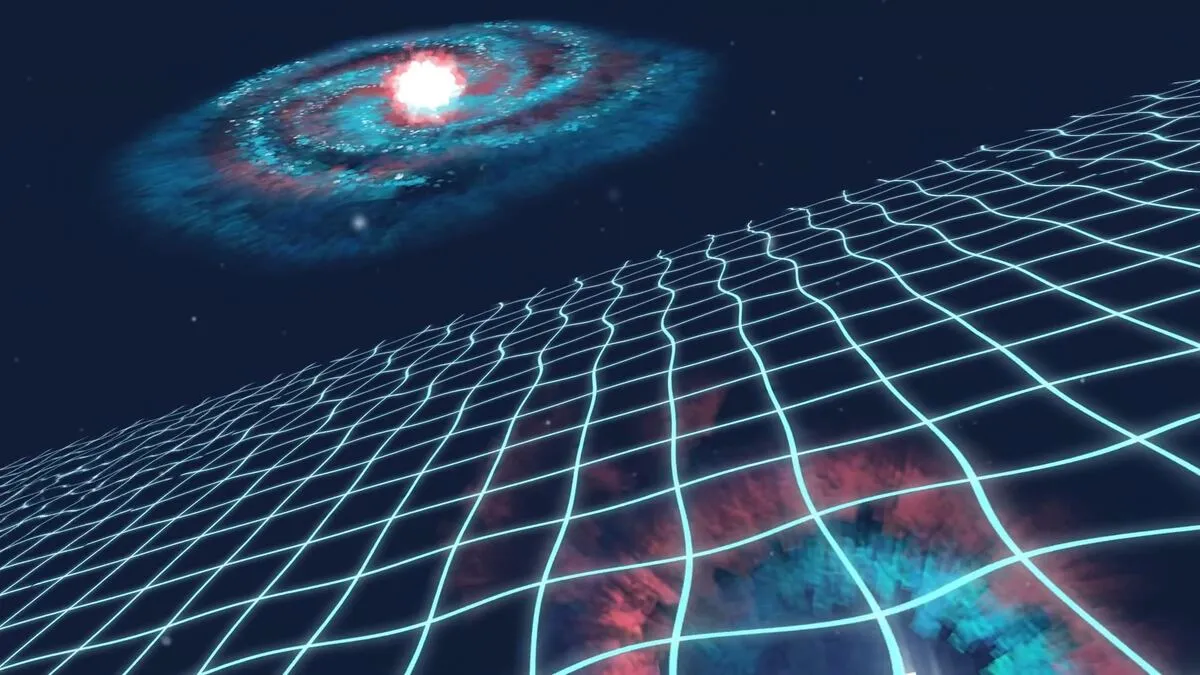
Pulsars may be revealing faint ripples in the fabric of the universe, ultra–low-frequency gravitational waves moving through space itself. Signals detected by international pulsar timing array collaborations in 2023 could point to one of two possibilities: a stochastic gravitational-wave background (the combined hum of countless distant sources) or a single, nearby pair of orbiting supermassive black holes. The results of the study have been published in the Journal of Cosmology and Astroparticle Physics (JCAP).
To distinguish between these scenarios, theoretical physicist Hideki Asada, Professor at Hirosaki University, and Shun Yamamoto, researcher at the Graduate School of Science and Technology, Hirosaki University, have proposed a new approach. Their method looks for beat phenomena that occur when gravitational waves of nearly identical frequencies interact, leaving subtle marks in the timing of pulsars’ radio pulses as they reach Earth.
The night sky is home to incredibly precise “cosmic clocks”: pulsars, dense, rapidly rotating neutron stars that emit regular bursts of radio waves, ticking with remarkable consistency. Astronomers use radio telescopes on Earth to measure these pulses, both to study the pulsars themselves and to use them as natural instruments for exploring the structure of the universe.
If something unseen—almost a “cosmic ghost”—bends spacetime between a pulsar and Earth, the rhythm of its pulses subtly changes. These distortions are not random; they appear in coordinated patterns across multiple pulsars in certain parts of the sky, as if a giant ripple were passing through the cosmos.
“In 2023 several pulsar timing array collaborations—NANOGrav in the US, and European teams—announced strong evidence for nanohertz gravitational waves,” Asada notes. Nanohertz means wave periods of months to years, with wavelengths of several light-years. To probe such scales, we rely on distant, stable pulsars hundreds to thousands of light-years away. “The signal was statistically reliable but below the 5-sigma threshold that particle physicists usually require,” he continues. “It’s ‘strong evidence’ but not yet a confirmed detection, but the cosmology and astrophysics community believes we are approaching the first detection of nanohertz gravitational waves.”
For now, certainty is below the gold-standard threshold; if future data corroborate it, Asada argues, the next challenge is to identify the source. “There are two main candidate sources for nanohertz gravitational waves,” he explains. “One is cosmic inflation, which would have created spacetime fluctuations in the very early universe, later stretched to cosmic scales. The other is supermassive black hole binaries, which form when galaxies merge. Both scenarios could generate nanohertz gravitational waves.”
The difficulty is that the correlation patterns in pulsar data—the way timing residuals from different pulsars correlate—were long thought to look the same in both cases. “In our paper, we explored the situation where a nearby pair of supermassive black holes produces a particularly strong signal,” Asada says. “If two such systems have very similar frequencies, their waves can interfere and create a beat pattern, like in acoustics. That feature could, in principle, allow us to distinguish them from the stochastic background of inflation.”
Asada and Yamamoto, therefore, leverage a familiar acoustic effect: beats. When two waves have almost—but not exactly—the same frequency, their superposition produces periodic strengthening and weakening. Applied to gravitational waves, two supermassive-black-hole binaries with similar frequencies would imprint a characteristic modulation in the pulsar-timing signal. The method is to look for this modulation—the “beat”—in the pulsar correlation patterns. If it’s present, that strongly suggests the signal is not a diffuse background but arises from specific, relatively nearby binaries.
We now await stronger confirmation of the pulsar signal’s nature. “I think once a confirmed detection at 5-sigma is achieved, maybe within a few years, the next step will be to ask: what is the origin of the waves? At that point, our method could be useful to distinguish whether they come from inflation or from nearby supermassive black hole binaries,” Asada concludes.
4155/v


















