Pausing Cell Death Could Be Key to Longevity
Necrosis, a form of uncontrolled cell death, may hold one of the most promising keys to altering the course of human aging, disease, and even space travel, according to a new study by researchers at UCL, the drug discovery company LinkGevity, and the European Space Agency (ESA). Published in Nature Oncogene, the study brings together an international team of scientists and clinicians to explore how necrosis, when cells die suddenly due to infection, injury, or disease, could transform our understanding and treatment of age-related conditions.
Challenging conventional thinking, the paper draws on evidence from cancer biology, regenerative medicine, kidney disease, and space health to argue that necrosis is not just a final stage of cell death, but a major driver of aging—and a potential target for intervention.
Dr. Keith Siew, an author of the study from UCL Centre for Kidney & Bladder Health, said: “Nobody really likes talking about death, even cell death, which is perhaps why the physiology of death is so poorly understood. And in a way, necrosis is death. If enough cells die, then tissues die, then we die. The question is what would happen if we could pause or stop necrosis.”
Dr. Carina Kern, lead author of the study and CEO of LinkGevity, a biotech company based at Cambridge’s Babraham Research Campus and part of the NASA Space-Health program, said: “Necrosis remains one of the last frontiers in medicine – a common thread across aging, disease, space biology, and scientific progress itself.”
Cells are the basic building blocks of life and can die in several different ways. Programmed cell death is a beneficial, tightly regulated process that helps tissues renew themselves and maintain proper function throughout life.
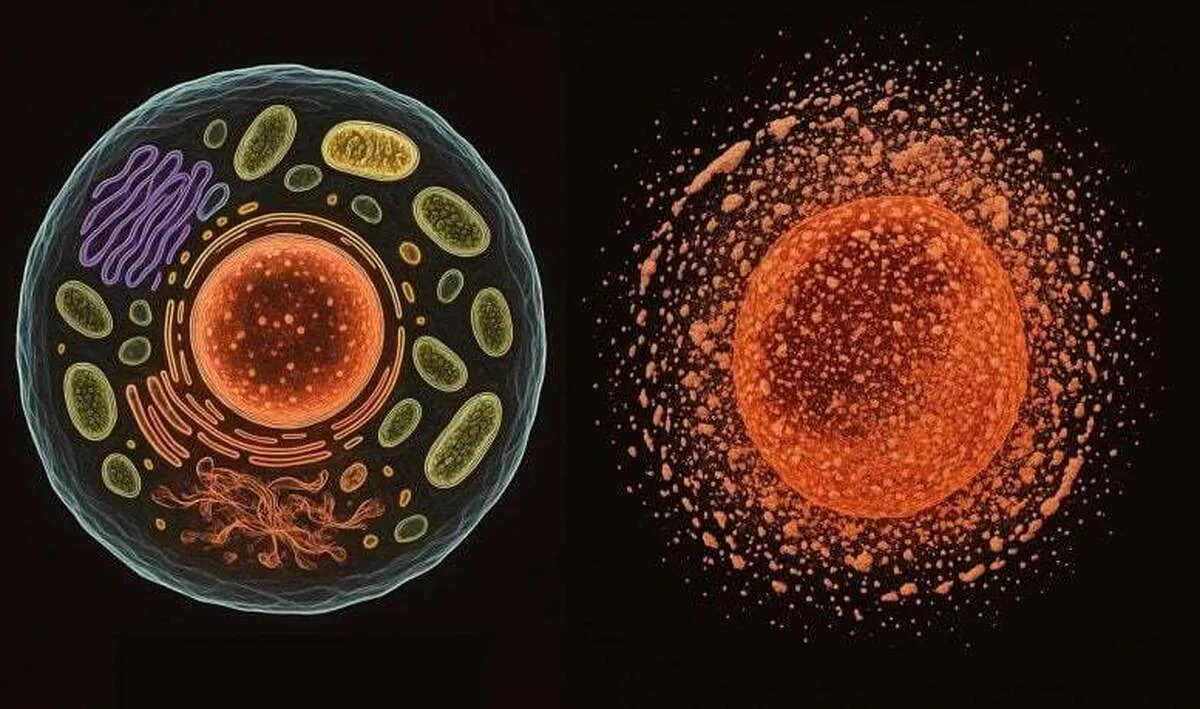
In contrast, unprogrammed cell death, known as necrosis, is an uncontrolled and damaging process that causes tissue breakdown and contributes to overall biological decline.
When this finely tuned balance fails, calcium floods the cell like an electrical short circuit, pushing the cell into chaos. Unlike programmed death, where cells dismantle in an orderly manner, necrosis causes cells to rupture, spilling toxic molecules into surrounding tissues.
This sparks a chain reaction that causes widespread inflammation and affects tissue repair, creating a snowball effect that ultimately leads to frailty and the onset of chronic age-related conditions such as kidney disease, heart disease, and Alzheimer’s.
Dr. Siew added: “When cells die, it’s not always a peaceful process for the neighbors.”
Dr. Kern explains: “Necrosis has been hiding in plain sight. As a final stage of cell death, it’s been largely overlooked. But mounting evidence shows it’s far more than an endpoint. It’s a central mechanism through which systemic degeneration not only arises but also spreads. That makes it a critical point of convergence across many diseases. If we can target necrosis, we could unlock entirely new ways to treat conditions ranging from kidney failure to cardiac disease, neurodegeneration, and even aging itself.”
Notably, it is in the kidneys that necrosis may have its most devastating and underappreciated impact. Necrosis induces kidney disease, which can lead to kidney failure requiring a transplant or dialysis. By age 75 nearly half of all individuals develop some degree of kidney disease as part of the natural aging process.
Dr. Siew added, “With kidney disease, there’s no one underlying reason that the kidneys fail. It could be a lack of oxygen, inflammation, oxidative stress, a build-up of toxins, and so on. All of these stressors eventually lead to necrosis, which initiates a positive feedback loop that spirals out of control, leading to kidney failure. We can’t stop all of these stressors, but if you could intervene at the point of necrosis, you’d effectively achieve the same result.”
Another area where interrupting necrosis could have a big impact is spaceflight, where astronauts often experience accelerated aging and kidney-related decline due to the effects of low gravity and exposure to cosmic radiation. A 2024 study involving Dr. Siew demonstrated that the human kidney may be the ultimate bottleneck for long-duration space missions.
The authors say finding solutions to this accelerated aging and kidney disease may be the final frontier for human deep space exploration.
Professor Damian Bailey, an author of the paper from the University of South Wales and Chair of the European Space Agency (ESA) Life Sciences Working Group, said: “Targeting necrosis offers potential to not only transform longevity on Earth but also push the frontiers of space exploration. In space, the same factors that cause aging on Earth are made worse by cosmic radiation and microgravity, speeding up degeneration dramatically.”
Dr. Kern added: “In many age-related diseases – affecting diverse organs such as the lungs, kidneys, liver, brain, and cardiovascular system – relentless cascades of necrosis fuel the progression of disease. This is often alongside impaired healing that leads to fibrosis, inflammation, and damaged cells. Each cascade triggers and amplifies the next.
“If we could prevent necrosis, even temporarily, we would be shutting down these destructive cycles at their source, enabling normal physiological processes and cell division to resume – and potentially even allowing for regeneration.”
4155/v