Iranian Researchers Find Way to Speed Up Movement of Nanoparticles
The research was conducted by Mo’ein Taheri, an associate professor of the Department of Manufacturing Engineering at Arak University, and Fereshteh Qaneh, a bachelor's student in the same department.
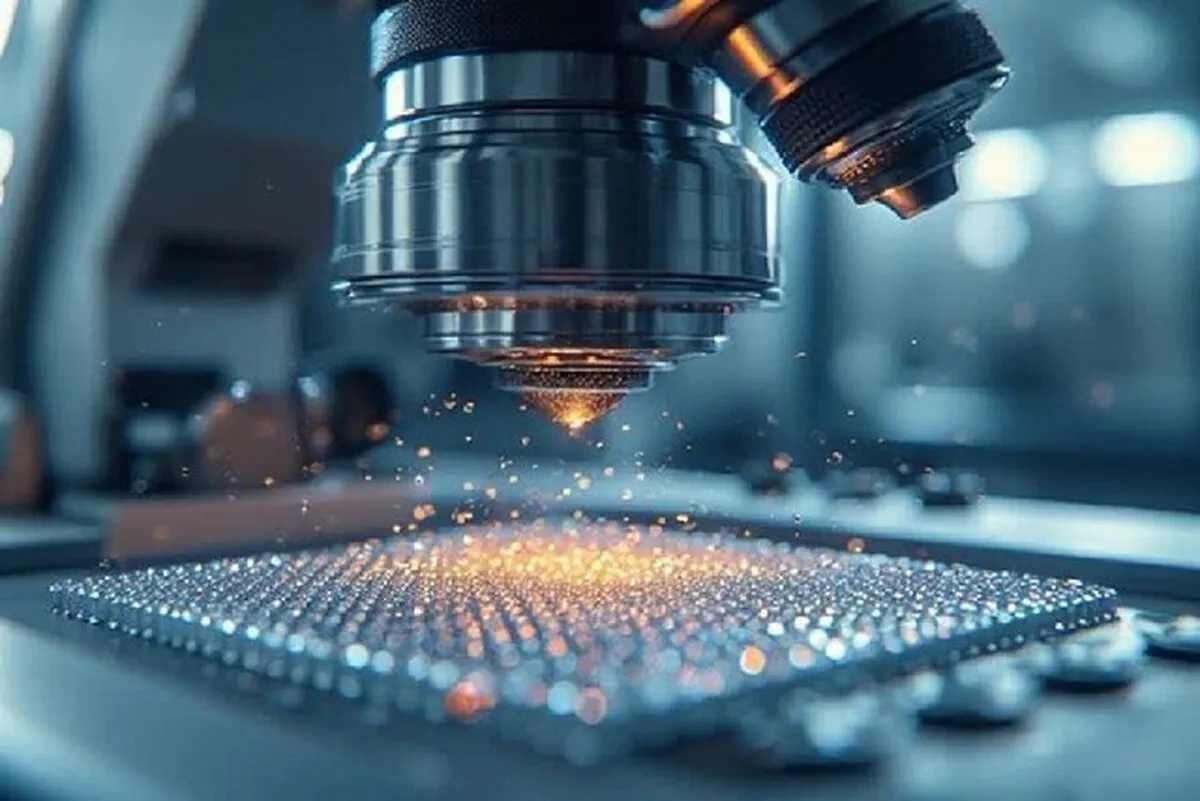
Based on the research, moving particles at the nano and micro scale using atomic force microscopy (AFM) is known as one of the advanced methods in nanotechnology. One of the key factors in increasing the accuracy and efficiency of this process is reducing the critical time for manipulation.
In this study, the effect of the dimensional parameters of the AFM microcantilever, including the thickness, width, and length of the cantilever, and the radius and height of its tip, on the critical time was investigated.
Response surface methodology (RSM) was used to analyze the data and develop the mathematical model. The results showed that the presented regression model has a prediction accuracy of 91.04% and among the factors studied, the cantilever thickness has the greatest impact on the critical time of nanoparticle manipulation.
This finding can be considered an important step in improving the accuracy and speed of nanomanipulation technology and its applications in various fields of nanotechnology.
In a relevant development in December, another Iranian knowledge-based company stationed at Pardis Science and Technology Park had managed to produce an atomic force microscope which is used to image and characterize samples at the nanoscale.
“One of our knowledge-based products is the atomic force microscope, which is used to image and characterize samples at the nanoscale. This device uses a sharp-pointed probe to scan the sample surface. During the scanning operation, laser light is emitted to the back of the cantilever and its reflection on a photodiode will result in the formation of an image of the sample surface,” said Seyed Abbas Shahmoradi, the managing director of the knowledge-based company.
He mentioned the Bio-AFM as another achievement of his company, and said, "This microscope is one of the most important tools for studying samples in biology, because Bio-AFM provides a suitable platform for integrating atomic force microscopy and optical microscopy in biological research projects."
Noting that the Bio-AFM microscope can capture images in different environments with diverse working modes, Shahmoradi said, “This capability allows scientists to study the structure and properties of living cells and other biological samples like DNA and RNA, proteins, viruses, bacteria, and tissues."
“Also, the Transmission Electron Microscopy (TEM) produced by our company, with an accuracy of 0.6 nanometers, is capable of providing images with extremely high resolution. For comparison, the size of the coronavirus is 120 nanometers, while the accuracy of our device is one two-hundredth of this value,” he added.
4155/v