Mysterious Radio Signals Reveal What’s Hiding between Galaxies
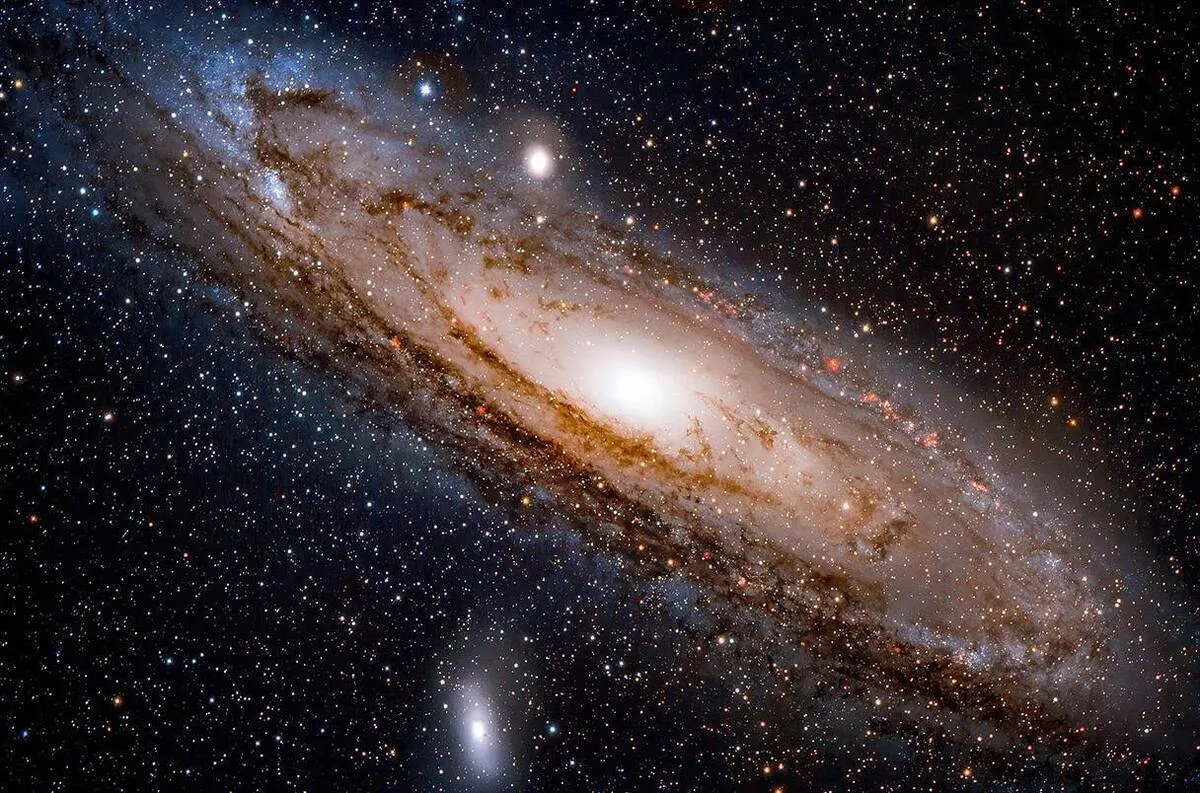
Most of the matter that exists in the universe is invisible and can only be detected by how it affects gravity. This form is known as dark matter. In contrast, the type of matter we’re more familiar with, from atoms to planets to people, makes up just 16 percent of all matter. Known as ordinary or “baryonic” matter, this form emits light, making it observable. However, much of it is spread out in very thin amounts, either within the halos that surround galaxies or floating between galaxies across vast distances, the journal Nature Astronomy reported.
Because this matter is so spread out, scientists had long been unable to detect about half of it. This “missing” portion remained unaccounted for—until now.
In a study, researchers from Caltech and the Center for Astrophysics | Harvard & Smithsonian (CfA) report that they have successfully found and measured the previously missing ordinary matter for the first time. To do this, they used bursts of radio waves from space called fast radio bursts (FRBs), which are brief, powerful flashes of energy that travel across billions of light-years.
“The FRBs shine through the fog of the intergalactic medium, and by precisely measuring how the light slows down, we can weigh that fog, even when it’s too faint to see,” says Liam Connor, assistant professor at Harvard and lead author of the study, who performed much of the work while a Caltech research assistant professor working with Vikram Ravi, assistant professor of astronomy at Caltech.
The team studied 69 different FRBs, each located at distances ranging from roughly 11.74 million to 9.1 billion light-years away. The farthest one in the study, known as FRB 20230521B, is the most distant FRB ever recorded. Although over a thousand FRBs have been discovered to date, only about 100 of them have been traced back to the galaxies they originated from. This specific subset, where both location and distance are known, was essential for the researchers’ measurements.
Of the 69 FRBs used in the analysis, 39 were identified using the Deep Synoptic Array-110 (DSA-110), a network of 110 radio telescopes funded by the National Science Foundation and based at Caltech’s Owen Valley Radio Observatory near Bishop, California. The DSA-110 is purpose-built to detect and pinpoint FRBs. After spotting these bursts, the team used additional telescopes, including the W. M. Keck Observatory in Hawaii and Palomar Observatory near San Diego, to measure how far away the bursts originated. The remaining 30 FRBs came from telescopes in other parts of the world, with most detected by the Australian Square Kilometre Array Pathfinder.
These FRBs, though fascinating in their own right, were used in this study to detect the missing ordinary matter; other techniques had only hinted at its existence. As radio-frequency light travels from the FRBs to Earth, the light becomes spread out into different wavelengths like a prism turns sunlight into a rainbow. The degree of this spreading, or dispersion, depends on how much matter is in the path of the light.
“It’s like we’re seeing the shadow of all the baryons, with FRBs as the backlight,” says Ravi. “If you see a person in front of you, you can find out a lot about them. But if you just see their shadow, you still know that they’re there and roughly how big they are.”
The results revealed that 76 percent of the universe’s normal matter lies in the space between galaxies, also known as the intergalactic medium. About 15 percent resides in galaxy halos, and the remainder is concentrated within galaxies—in stars or in cold galactic gas. This distribution lines up with predictions from advanced cosmological simulations but has never been observationally confirmed until now.
The findings will help researchers better understand how galaxies grow, and also demonstrate how FRBs can help with problems in cosmology, including the determination of the typical mass of subatomic particles called neutrinos. (The neutrino mass depends on the degree to which baryons cluster.) The standard model of physics predicts that neutrinos should have no mass, but observations have shown that these particles do have an incredibly tiny amount. Knowing the precise mass of neutrinos may therefore lead to new physics beyond the standard model of particle physics.
According to Ravi, this is just the beginning of the use of FRBs in cosmology. In the future, Caltech’s DSA-2000 radio telescope in the Nevada desert, currently in the planning stage, will build upon studies like this one. The radio array will find and localize up to 10,000 FRBs per year, dramatically enhancing their role as probes of normal matter and deepening our overall knowledge of the extreme blasts.
4155/v