AI Simulates 4 Billion Atoms to Build Better Materials
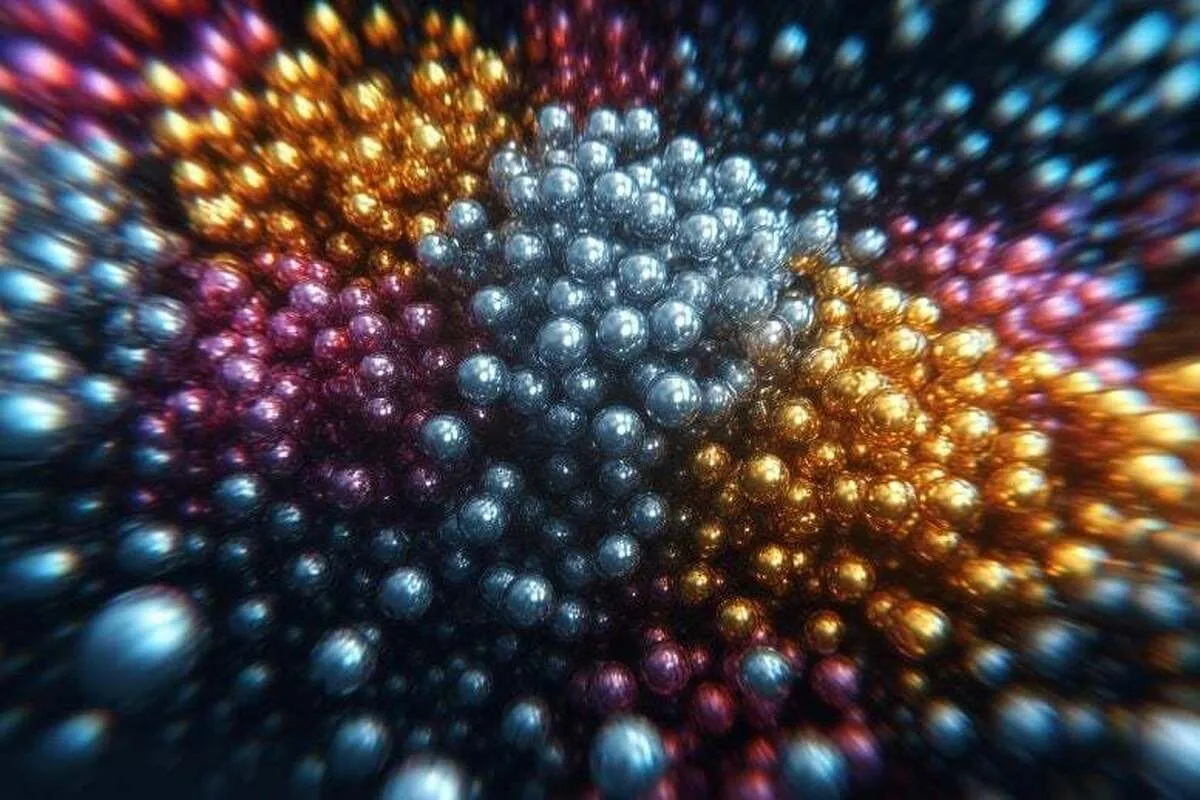
This breakthrough enables the design of next-generation concrete that captures carbon dioxide and could last for centuries—possibly even rivaling the durability of ancient Roman structures, the Journal of Physical Chemistry Letters reported.
Picture a future where the concrete used in buildings and bridges not only resists aging and extreme conditions, such as intense wildfire heat, but also repairs itself or absorbs carbon dioxide from the air.
Scientists at the USC Viterbi School of Engineering have now introduced a groundbreaking artificial intelligence model capable of simulating billions of atoms at once. This advancement unlocks a new era in material design, enabling discoveries at a scale previously thought impossible.
Climate change is rapidly intensifying. Droughts, melting glaciers, and increasingly destructive storms and wildfires are becoming more frequent and severe. A key factor driving global warming is the steady release of carbon dioxide into the atmosphere.
After witnessing the devastating January wildfires in Los Angeles, USC Viterbi professor Aiichiro Nakano (who specializes in computer science, physics, astronomy, and computational biology) began rethinking how science could help. He contacted longtime research collaborator Ken-Ichi Nomura, a fellow USC Viterbi professor with expertise in chemical engineering and materials science. The two have worked together for over two decades.
Their conversation led to the creation of Allegro-FM, an advanced AI-powered simulation platform. In their theoretical research, the model revealed something remarkable: it may be possible to reabsorb the carbon dioxide released during concrete production by embedding it back into the same material.
“You can just put the CO2 inside the concrete, and then that makes a carbon-neutral concrete,” Nakano said.
Nakano and Nomura, along with Priya Vashishta, a USC Viterbi professor of chemical engineering and materials science, and Rajiv Kalia, a USC professor of physics and astronomy, have been doing research on what they call “CO2 sequestration,” or the process of recapturing carbon dioxide and storing it, a challenging process.
By simulating billions of atoms simultaneously, Allegro-FM can test different concrete chemistries virtually before expensive real-world experiments. This could accelerate the development of concrete that acts as a carbon sink rather than just a carbon source — concrete production currently accounts for about 8% of global CO2 emissions.
The breakthrough lies in the model’s scalability. While existing molecular simulation methods are limited to systems with thousands or millions of atoms, Allegro-FM demonstrated 97.5% efficiency when simulating over four billion atoms on the Aurora supercomputer at Argonne National Laboratory.
This represents computational capabilities roughly 1,000 times larger than conventional approaches.
The model also covers 89 chemical elements and can predict molecular behavior for applications ranging from cement chemistry to carbon storage.
“Concrete is also a very complex material. It consists of many elements and different phases and interfaces. So, traditionally, we didn’t have a way to simulate phenomena involving concrete material. But now we can use this Allegro-FM to simulate mechanical properties [and] structural properties,” Nomura said.
Concrete is a fire-resistant material, making it an ideal building choice in the wake of the January wildfires. But concrete production is also a huge emitter of carbon dioxide, a particularly concerning environmental problem in a city like Los Angeles. In their simulations, Allegro-FM has been shown to be carbon neutral, making it a better choice than other concrete.
This breakthrough doesn’t only solve one problem. Modern concrete only lasts about 100 years on average, whereas ancient Roman concrete has lasted for over 2,000 years. But the recapture of CO2 can help this as well.
“If you put in the CO2, the so-called ‘carbonate layer,’ it becomes more robust,” Nakano said.
In other words, Allegro-FM can simulate a carbon-neutral concrete that could also last much longer than the 100 years concrete typically lasts nowadays. Now it’s just a matter of building it.
The professors led the development of Allegro-FM with an appreciation for how AI has been an accelerator of their complex work. Normally, to simulate the behavior of atoms, the professors would need a precise series of mathematical formulas — or, as Nomura called them, “profound, deep quantum mechanics phenomena.”
But the last two years have changed the way the two research.
“Now, because of this machine-learning AI breakthrough, instead of deriving all these quantum mechanics from scratch, researchers are taking [the] approach of generating a training set and then letting the machine learning model run,” Nomura said. This makes the professors’ process much faster as well as more efficient in its technology use.
Allegro-FM can accurately predict “interaction functions” between atoms — in other words, how atoms react and interact with each other. Normally, these interaction functions would require lots of individual simulations.
But this new model changes that. Originally, there were different equations for individual elements within the periodic table, with several unique functions for these elements. With the help of AI and machine-learning, though, we can now potentially simulate these interaction functions with nearly the entire periodic table at the same time, without the requirement for separate formulas.
“The traditional approach is to simulate a certain set of materials. So, you can simulate, let’s say, silica glass, but you cannot simulate [that] with, let’s say, a drug molecule,” Nomura said.
This new system is also a lot more efficient on the technology side, with AI models making lots of precise calculations that used to be done by a large supercomputer, simplifying tasks and freeing up that supercomputer’s resources for more advanced research.
“[The AI can] achieve quantum mechanical accuracy with much, much smaller computing resources,” Nakano said.
Nomura and Nakano say their work is far from over.
“We will certainly continue this concrete study research, making more complex geometries and surfaces,” Nomura said.
4155/v