Scientists Develop New Method to Detect Nanoplastics in Body Fluids
Microplastics, and the even smaller nanoplastics, can enter the human body through various pathways, such as food consumption or inhalation. While a large portion is excreted, some particles remain in the body, accumulating in organs, the bloodstream, and other bodily fluids, the journal Analytical Chemistry reported.
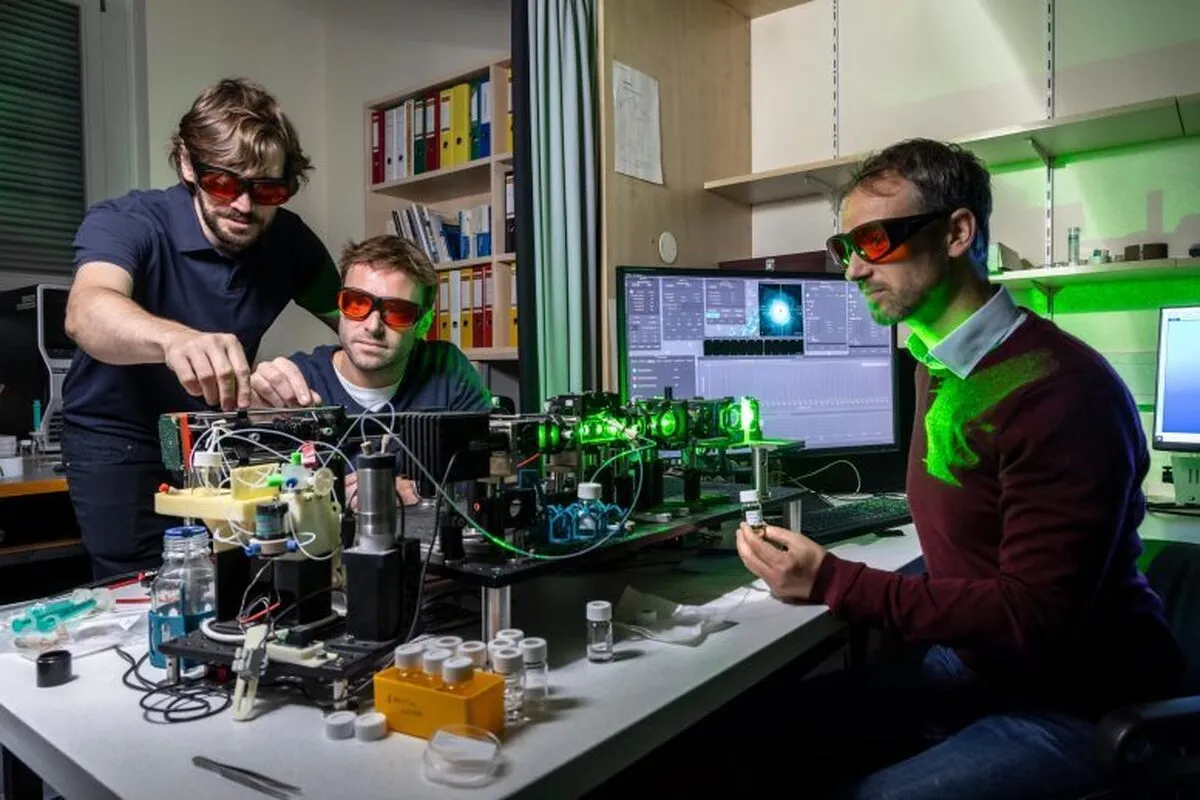
The FFG-funded BRIDGE project Nano-VISION, launched two years ago in collaboration with the start-up BRAVE Analytics, set out to explore whether nanoplastics could have implications in the field of ophthalmology. The research team, led by Harald Fitzek from the Institute of Electron Microscopy and Nanoanalysis at Graz University of Technology (TU Graz), worked alongside a Graz-based ophthalmologist to investigate this question.
The project has successfully developed a method to detect and measure nanoplastics in transparent body fluids, as well as to analyze their chemical composition.
As an exemplary application of the method, the research team is investigating whether intraocular lenses release nanoplastics. There have been no such studies to date, and initial results have already been submitted to a scientific journal.
Micro- and nanoplastics are detected in two steps. The sensor platform developed by BRAVE Analytics draws in the liquid to be analyzed and pumps it through a glass tube. There, a weakly focused laser is shone through the liquid in or against the direction of flow. If the light hits any particles, the laser pulse accelerates or decelerates them – larger particles more strongly than smaller ones.
The different velocity values allow conclusions to be drawn about the size of the particles and their concentration in the liquid. This method, called optofluidic force induction, was developed by Christian Hill from BRAVE Analytics at the Medical University of Graz.
What is new is the combination of optofluidic force induction with Raman spectroscopy. Now the spectrum of the laser light scattered by individual particles in the liquid is also analysed. A small part of the light, the so-called Raman scattering, has a different frequency to the laser itself and thus allows conclusions to be drawn about the composition of the particles.
“Depending on the material of the focused particles, the frequency values are slightly different in each case and thus reveal the exact chemical composition,” says Raman spectroscopy expert Harald Fitzek. “This works particularly well with organic materials and plastics.”
The Institute of Electron Microscopy and Nanoanalysis is currently conducting further investigations into the extent to which intraocular lenses yield nanoplastics spontaneously, after mechanical stress or when exposed to laser energy. The findings from these tests are extremely important for ophthalmic surgeons and lens manufacturers and will be published in a scientific journal.
“Our method for detecting micro- and nanoplastics can be applied to clear body fluids such as urine, tear fluid, or blood plasma,” says Harald Fitzek. “However, it is also suitable for the continuous monitoring of liquid flows in industry as well as drinking and wastewater.”
4155/v