Chinese Scientists Develop a Robotic Arm with Human-Like Tactile Sensing
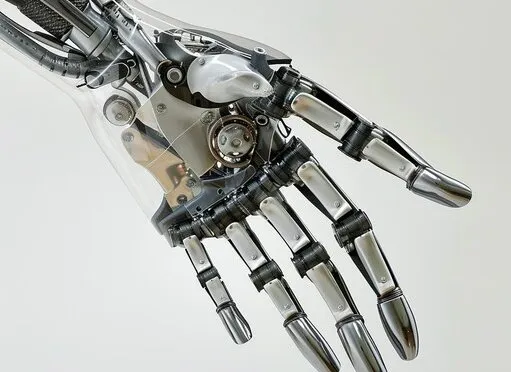
A research team at the Hong Kong University of Science and Technology (HKUST) has developed an integrated sensorimotor robotic arm, known as EmArm, featuring full-arm tactile sensing and adaptive manipulation capabilities.
By directly integrating a soft optical tactile skin onto the robotic skeleton and combining it with a real-time decision-making algorithm, EmArm can acquire and analyze contact information across its upper arm and forearm. This enables human-like tactile perception and adaptive object manipulation. The system can also distinguish between different types of tactile interactions, such as tickling and gentle tapping, respond in real time, and avoid obstacles through tactile feedback. These capabilities open up new possibilities for developing intelligent embodied robots.
Inspired by the human body's bone-muscle-skin architecture, the research team embedded an extensive soft optical tactile skin into EmArm's rigid mechanical skeleton, combining the ability to handle heavy loads with soft tactile sensing. More than 71,000 square millimeters of this soft tactile skin cover the robot's upper arm and forearm, while internal submillimeter-scale cameras analyze the distribution of forces applied to the robotic arm.
EmArm achieves a spatial resolution of 0.085 millimeters, comparable to that of human fingertip skin. Its two-point discrimination threshold can reach 18.2 millimeters, outperforming the typical range of 30–50 millimeters for human arm skin and enabling more precise discrimination between separate contact points.
The optical sensing approach eliminates the need for the complex wiring associated with electronic skin and is inherently resistant to electromagnetic, optical, thermal, humidity-related, and acoustic interference. Experiments showed that EmArm maintained a sensing accuracy of up to 97.9 percent when exposed to five types of environmental interference.
The integrated tactile skin had no appreciable adverse effect on the robotic arm's performance under heavy loads. Tests also showed that EmArm achieved positioning repeatability comparable to that of conventional robotic arms. The system combines full-arm tactile sensing with high-precision actuators in an integrated architecture built around sensorimotor interaction.
Shen Yajing, who led the research, said: “For robots to acquire perceptual capabilities, what matters more than obtaining accurate raw signals from sensors is how quickly those signals can be decoded so that the robot can understand what the tactile information means and how to act on it.”
To transform EmArm from a sensor into an intelligent agent, the research team proposed a perception-action loop. This framework integrates joint-angle data, representing proprioceptive input, with tactile information, representing exteroceptive input, in real time. It extracts features such as contact position, contact area, force, and the number of contact points to enable autonomous decision-making. The resulting sensory data are then fed directly into the robotic arm's motion-control system.
EmArm represents a major advance in sensing technology and reflects a broader shift in robotic design—from “connected external perception” toward “intrinsic intelligence,” and from “visual dominance” toward “multimodal integration.”
The researchers noted that EmArm's technology could be extended to other robotic body parts, including legs and torsos, enabling safer and more adaptive interactions by humanoid robots in domestic services, industrial environments, medical assistance, and other applications.
The system could also contribute to advances in embodied artificial intelligence, in which AI systems equipped with physical bodies perceive, interact with, and learn from the real world.