Modern Donkey Farming
This renewed focus is driven by several emerging sectors: sustainable ecotourism where gentle, sure-footed animals are preferred; niche agricultural production, particularly the high-value market for donkey milk; and their inherent suitability as hardy, low-maintenance companion or working animals in challenging environments, a report by chatgpt said.
The transition from traditional, often rudimentary, donkey management to a modern, efficient farming system is critical for profitability, sustainability, and animal welfare. Modern donkey farming emphasizes proactive health management, precision nutrition, and data-driven decision-making, moving away from reactive care based purely on observation. This report outlines the essential pillars required to establish and operate a successful modern donkey farm.
II. Establishment Phase
The foundation of a successful farm lies in meticulous planning during the establishment phase, focusing heavily on infrastructure tailored specifically to the unique needs of donkeys, which differ physiologically and behaviorally from horses.
1. Site Selection and Infrastructure
A. Land Requirements and Climate Considerations:
Donkeys are generally hardier than horses but still require appropriate space and shelter.
Space Allocation: While exact stocking rates depend on the intensity of use (e.g., intensive milk production versus extensive grazing), a general guideline suggests a minimum of 0.5 to 1 acre per adult donkey for rotational grazing, ensuring pasture recovery. Overstocking leads to parasite burden escalation and pasture degradation.
Terrain: Donkeys originate from arid, often rocky environments. While they tolerate various terrains, excellent drainage is paramount. Muddy conditions lead rapidly to serious hoof problems (e.g., thrush, abscesses). Avoid areas prone to standing water.
Climate Adaptation: Shelters must address local climate extremes. In hot, humid climates, maximal airflow is essential. In cold, wet climates, protection from driving rain and wind is more critical than insulation.
B. Fencing and Security:
Donkeys are notoriously skillful at escaping enclosures. Fencing must be robust, visible, and secure.
Fence Height and Material: Standard horse fencing (e.g., wood board or high-tensile electric wire) is often effective. Fences should be a minimum of 48 inches high. If using wire, use smooth wire; barbed wire is strongly discouraged due to the risk of severe injury.
Visibility: Donkeys have a poorer depth perception than horses. Fences should be highly visible. For low-visibility areas, paint posts white or use thicker horizontal rails.
Internal Paddock Division: Implement a rotational grazing system using temporary electric fencing to manage pasture quality and parasite load.
C. Shelter Design:
Donkeys prefer overhead cover rather than fully enclosed barns. Their primary need is protection from wetness and direct sun/wind, not warmth.
Three-Sided Run-In Shelters: These are often ideal. They must be situated to block prevailing winds and rain.
Ventilation: Crucial, especially in humid environments, to prevent respiratory issues. The structure should allow free air movement overhead and at ground level.
Flooring: Stalls or sheltered areas should be raised slightly or well-drained, using deep, absorbent bedding (e.g., straw, wood shavings) which must be changed frequently to maintain hygiene.
D. Essential Equipment:
Water Systems: Access to clean, fresh water 24/7 is non-negotiable. Heated waterers may be necessary in freezing climates. Automatic float systems minimize labor and ensure consistent supply.
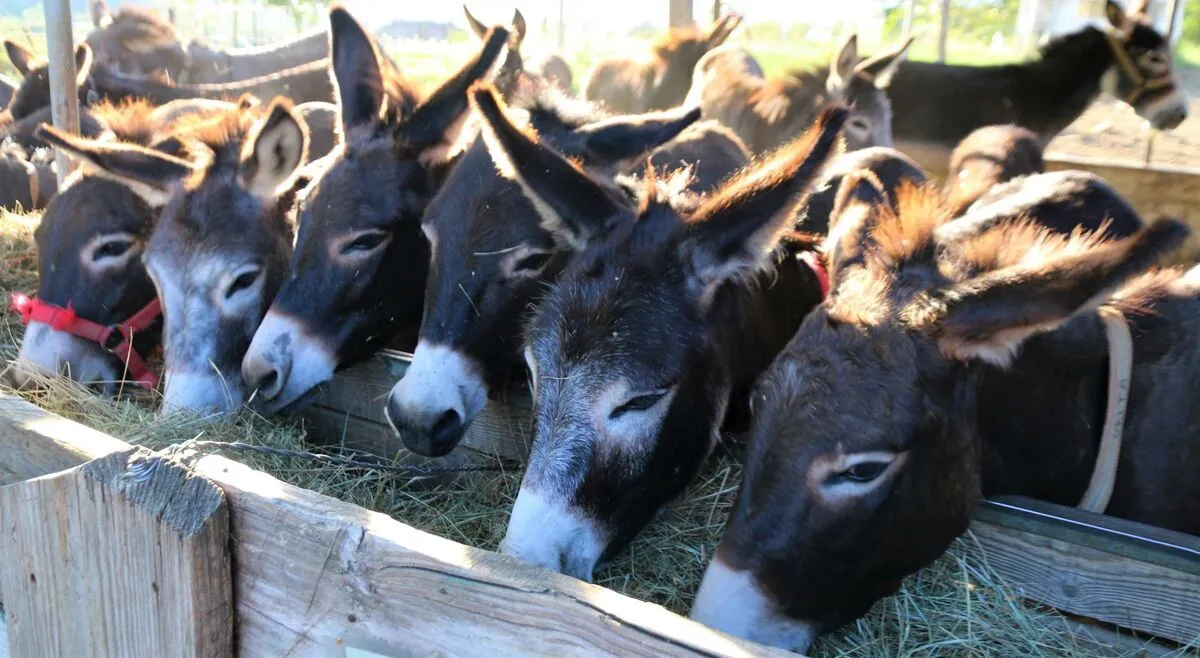
Feeding Troughs: Troughs should be sturdy and raised to a comfortable height (approximately chest level for an average donkey) to encourage proper neck posture and reduce dust inhalation. Slow-feed nets or specialized slow-feeders are recommended to mimic natural grazing behavior and prevent rapid ingestion, which can lead to obesity and associated metabolic issues.
2. Stock Acquisition
Sourcing the correct foundation stock dictates the farm’s success, especially for breeding or tourism ventures.
Health Screening: All incoming animals must undergo a comprehensive veterinary examination, including:
Fecal egg count (FEC) testing to establish a baseline parasite load.
Blood work for infectious diseases relevant to the region (e.g., Equine Infectious Anemia, EIA).
Body Condition Scoring (BCS) assessment.
Temperament Assessment: Especially vital for tourism or handling-intensive operations (like milk harvesting). Animals should demonstrate calmness, trainability, and acceptance of human proximity without undue flightiness.
Breed Suitability:
Poitou or Mammoth Jacks: Prized for size, useful for heavy packing or producing larger mules.
Mediterranean or Miniature Donkeys: Popular for companion animals, petting zoos, or low-intensity tourism.
Native Breeds: Often possess superior hardiness suited to local climates.
Record Keeping Initialization: Immediately upon acquisition, assign a permanent identification number (tag, microchip, or tattoo) and begin a permanent health and genealogy file for each animal.
III. Operational Management
Modern management focuses on precise inputs matching the animal’s specific physiological requirements, rather than general feeding and routine care.
1. Nutrition and Feeding Programs
Donkeys evolved in harsh, arid environments with sparse vegetation. They are highly efficient at utilizing low-quality forage and are extremely prone to obesity and associated diseases like laminitis and hyperlipidemia if overfed.
A. Forage Basis:
The diet must be high in fiber and low in sugar (Non-Structural Carbohydrates, NSC).
Ideal Forage: Mature grass hay (low-quality meadow hay, barley straw, or oat straw) should form the bulk of the diet (ideally 75% or more of the dry matter intake).
Grazing Management: Pasture access must be severely restricted or managed using grazing muzzles, especially during spring growth spurts when grass sugar levels peak. If pastures are lush, strip grazing or tethering may be necessary.
B. Nutritional Requirements Calculation:
Maintenance energy requirements are often low. The standard daily dry matter intake (DMI) for a non-working adult donkey weighing $200 \text{ kg}$ is approximately $1.5% \text{ to } 2.5%$ of its body weight.
[ \text{DMI (kg/day)} = \text{BW(kg)} \times (0.015 \text{ to } 0.025) ]
C. Supplements:
Since forage quality is often intentionally low, essential vitamins and minerals must be supplemented to meet National Research Council (NRC) requirements.
Mineral Blocks/Loose Mix: Use a specific equine or donkey mineral mix, ensuring correct ratios of Calcium to Phosphorus (ideally $1.5:1$ to $2:1$). Monitor for excess copper or selenium, depending on regional soil profiles.
Feed Plans by Life Stage:
Foals (Growth): Require higher levels of protein and balanced minerals for skeletal development. Monitor growth rate closely to prevent developmental orthopedic disease (DOD).
Working Adults: May require a small quantity of concentrated feed (e.g., beet pulp, specialized low-starch pellets) to meet higher energy demands, often calculated based on work intensity.
Breeding Jennies (Late Gestation/Lactation): Energy and protein needs increase substantially in the last trimester and during nursing.
2. Health and Veterinary Care
Donkeys mask illness effectively. Proactive protocols are essential to detect subclinical issues before they become emergencies.
A. Proactive Health Protocol:
Annual Examinations: A thorough yearly visit by an experienced equine veterinarian is mandatory for assessment, dental floating, and vaccine protocol review.
Vaccination Schedule: Protocols must be tailored to regional disease risk. Core vaccines typically include Tetanus and Equine Influenza. Depending on locale, Eastern/Western Equine Encephalomyelitis (EEE/WEE) or Rabies may be recommended.
B. Deworming and Parasite Control:
Donkey digestive systems handle parasites differently than horses; they often develop higher tolerances to certain classes of dewormers.
Fecal Egg Count Reduction Testing (FECRT): This is the cornerstone of modern control. Regular FECs determine which parasites are present and the efficacy of the administered anthelmintic. Rotation of drug classes is essential to combat resistance.
Moxidectin and Ivermectin: These are generally considered the mainstays, but resistance patterns must be monitored regionally.
Tapeworms: Often overlooked, tapeworms are a significant concern in donkeys and require targeted treatment ($2 \times$ per year).
C. Lameness Prevention (Hoof Care):
Donkeys' hooves are denser and often require less frequent trimming than horses, but consistency is key.
Farrier Schedule: Typically every $6 \text{ to } 10$ weeks, depending on foot growth rate.
Trimming Philosophy: Aim to maintain the natural conformation. Over-trimming (removing too much heel) is a common and detrimental mistake made by farriers accustomed only to horses. The goal is to maintain a balanced foot with appropriate heel angle, avoiding flares, and managing the often-profoundly upright angle seen in some donkeys.
Thrush Management: Good drainage in housing is the primary defense against bacterial infection in the hoof sulci.
D. Recognizing Common Ailments:
Donkeys often present differently than horses when ill.
Colic: While possible, donkeys are less prone to spasmodic colic. Impaction colic (often associated with poor water intake or sudden dietary changes) is common. Signs might be subtle: lethargy, decreased fecal output, or leaning against a wall.
Hyperlipemia: A potentially fatal condition, especially in overweight donkeys undergoing stress or feed restriction. Symptoms include depression, reluctance to move, and potential staggering.
Dental Disease: Often presents as weight loss or dropping feed, rather than overt signs of pain during eating.
3. Breeding and Reproduction
Successful breeding relies on meticulous record-keeping and management of the donkey’s reproductive cycle.
Breeding Seasonality: Donkeys are generally seasonal breeders, often demonstrating heightened fertility in the spring and summer months, although many can be bred year-round under managed conditions.
Gestation Period: A lengthy average gestation of approximately $11.5 \text{ to } 12.5$ months (around $365 \text{ days}$)
Record Keeping: Precise tracking of the last mating date is vital for anticipating foaling and preparing care facilities.
Neonatal Care: Foaling is usually quick and straightforward. The mare-foal bonding period is sensitive. Ensure the foal is standing and nursing within $2 \text{ hours}$. Passive immunity relies on timely colostrum intake. Umbilical care (dipping the cord in iodine solution immediately after birth) is a critical biosecurity step.
IV. Sustainability and Technology Integration
Modern farming demands efficiency and minimal environmental impact, which technology can greatly facilitate.
1. Record Keeping and Data Management
Moving beyond paper files dramatically improves management oversight, allowing for quick identification of trends and deviations.
Farm Management Software (FMS): Utilize specialized software (or robust spreadsheets) for tracking:
Genealogy: Sire, dam, birth dates, and verification of parentage. This is crucial for preventing inbreeding and assessing economic traits.
Health History: Dates of vaccines, deworming results (FECRT), lameness episodes, and medication administration.
Production Data (If applicable): For milk production, tracking daily yield, quality checks (lactose, fat content), and lactation curve management.
Weight Tracking: Use a portable weigh scale periodically. Tracking weight changes provides the earliest indicator of diet issues or developing illness.
Body Condition Scoring (BCS): Standardized scoring (e.g., using a scale of 1 to 5, adapted for donkeys) must be recorded monthly. A target BCS of $2.5 \text{ to } 3.0$ is ideal; scores above $3.5$ indicate high risk for metabolic disease.
2. Waste Management and Resource Use
Donkey manure is an excellent, low-nitrogen fertilizer, provided it is managed correctly.
Composting: Dry, high-lignin manure is ideal for composting. Mix bedding and manure and turn regularly to ensure thermophilic composting kills pathogens and breaks down weed seeds. This turns a waste product into a high-value soil amendment.
Water Conservation: Implement drip lines for pasture irrigation if necessary, and ensure all water troughs have tight-fitting valves to prevent leakage, as donkeys drink significant amounts daily.
Forage Management: Utilizing slow-feed systems reduces waste significantly, as less hay is trampled and fouled.
V. Market and Profitability
The modern donkey farm must identify specialized revenue streams to offset the costs of high-welfare management.
Specialized Breeding Stock Sales: Selling high-quality, fully documented foundation stock, mules, or miniature donkeys to hobbyists or other commercial ventures. Proven breeding lines command premium prices.
Donkey Milk Production: This is a rapidly growing niche market. Donkey milk is prized for its high lactose and low-fat content, making it highly palatable for human consumption, particularly for infants allergic to cow's milk. This requires intensive daily milking management and strict hygiene protocols.
Agri-Tourism and Educational Experiences: Offering guided educational walks, packing demonstrations, or farm stays that highlight the unique history and temperament of donkeys. This requires excellent public relations skills and animals with exceptional temperaments.
Therapy and Companion Animals: Placement of temperament-tested, trained donkeys into therapy programs or as companion animals for horses/livestock.
Conclusion
Establishing a modern donkey farm is a venture requiring specialized knowledge distinct from traditional equine management. Success hinges on rigorous planning during the Establishment Phase, particularly in designing drainage and appropriate shelter systems. Operational Management must prioritize precision nutrition—keeping diets high in fiber and low in sugar—and proactive health surveillance, recognizing that donkeys often mask discomfort. By integrating digital Record Keeping and adopting sustainable waste practices, the modern donkey farm can achieve high welfare standards while capitalizing on emerging, high-value niche markets, ensuring both ethical stewardship and long-term profitability.
4155