Iranian Researcher Achieves Remarkable Success in Energy Extraction from Ocean
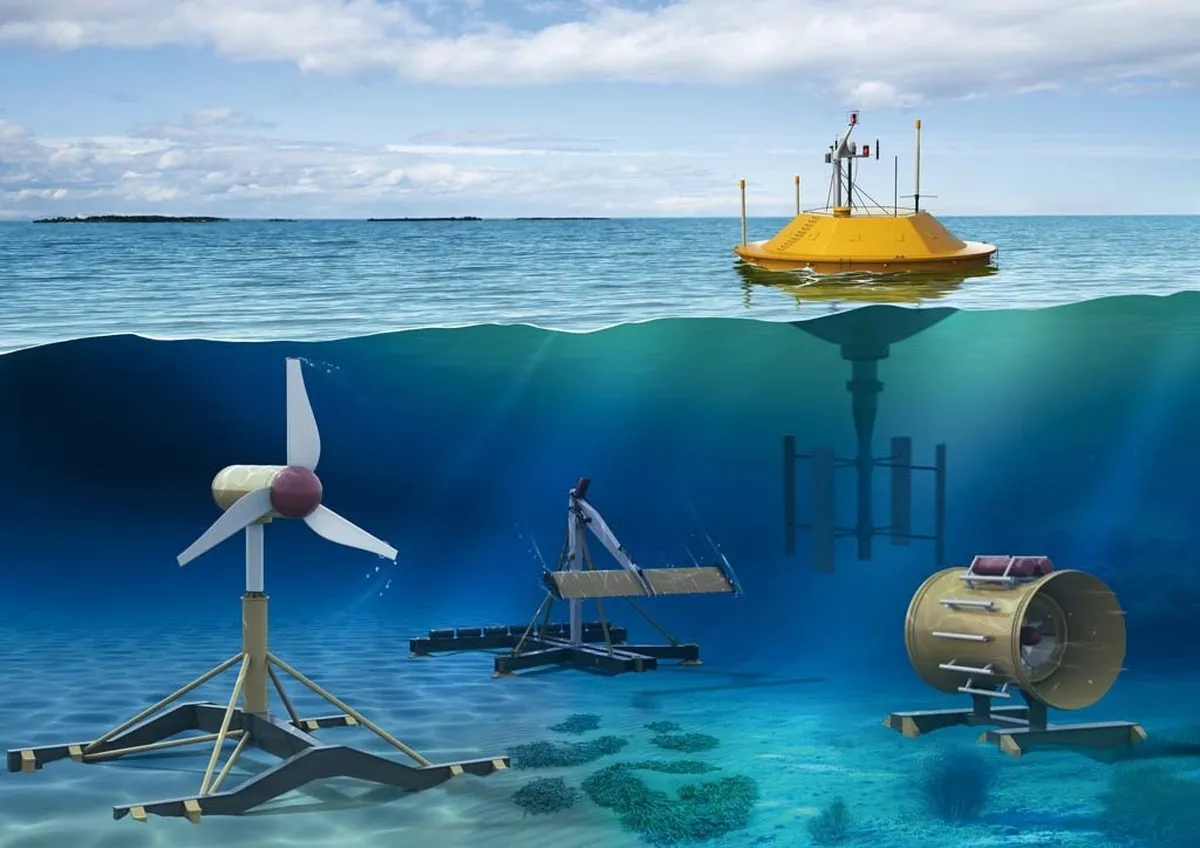
Alireza Rayeesi, a member of the Faculty of Mechanical Engineering, designed a system called the ‘Tethered Underwater Turbine Kite’ (TUSK), which can be a suitable alternative to fixed hydrodynamic turbines for extracting marine energy.
“Unlike fixed hydrodynamic turbines, the system consists of a kite with a turbine mounted under its wings. This kite is controlled in a way that it moves the turbine in a figure-eight-shaped path in the water, covering a large area at a relative speed that is several times faster than the actual speed of the underwater current,” he said.
Rayeesi explained that the research was carried out in two main parts, adding, “The first part includes flight dynamics and calculation of kite movement angles along the flight path, and the second part pertains to the design and analysis of a ducted turbine and numerical simulation of its movement in turbulent ocean currents.”
“The accuracy of the simulations performed using the momentum design theory of the blade element has been verified,” he noted.
Rayeesi said that the system achieved an average power of 383 kW and a power factor of about 1.19 per cycle, and said, "The efficiency of this system is far beyond that of conventional hydrodynamic turbines."
In a relevant development in 2022, a young Iranian inventor had also made a new model of breakwater to absorb the energy of waves and generate electricity.
“The general shape of the breakwater consists of a rectangular and prismatic cube in the front part of which a number of moving plates have been installed that absorb the energy of waves, and certain systems exist inside the breakwater that transfer the energy to the tanks and the under-pressure water is transferred to system and then collides with the turbine and the process of electricity generation occurs and then the water is transferred to the backside of the breakwater,” Mohammad Sharifi, a mechanical engineer and the inventor of the breakwater, told ANA.
He added that among the most important advantages of the project mention can be made of removal of water stagnation behind the breakwater, electricity generation, creation of natural ponds to breed aquatic animals, creation of a safe recreational area, the possibility of ship mooring, faster construction process, macro-economic savings, quick placement and operation.
“Based on assessments that I have had in this field, no similar system has been patented nationally and internationally so far and I hope that we can be supported and go ahead with the plan,” Sharifi said.
4155/v