AI predicts cancer patients’ survival chances from facial photographs
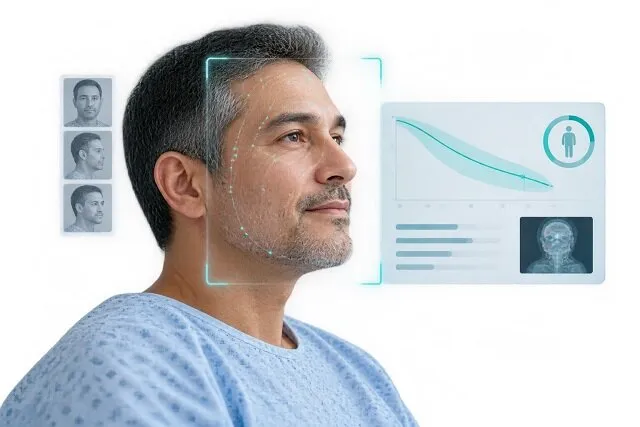
Chronological age is the number of years a person has lived. Biological age, by contrast, reflects the body’s condition and the extent of its aging. The two do not always match. Some people appear younger or older than their actual age. This difference may be associated with various factors and could offer clues about overall health.
Understanding this relationship is important in cancer care. Physicians need information about each patient’s condition to select and adjust treatments. A simple facial photograph could potentially provide additional clues. Combined with other medical information, it may help improve patient assessments.
Predicting outcomes for cancer patients is challenging. No single factor can determine an individual’s future with certainty. However, methods that analyze available information quickly and at relatively low cost could support treatment decisions. Facial features may reveal characteristics that are difficult to measure through ordinary observation.
Researchers are investigating whether AI can identify facial cues associated with biological age and survival. This approach remains experimental. Further studies are needed before it can be used in clinical practice. It should not serve as the sole basis for medical decisions.
Researchers at Harvard Medical School in the United States developed two AI tools based on a model called Fear-Face. The study aimed to estimate biological age from facial photographs and predict survival directly from images. The work builds on the team’s earlier model, FaceAge. The new model was trained on a much larger and more diverse collection of photographs.
The main model was trained on more than 40 million publicly available facial photographs. According to the study, the dataset covered a wider age range and greater ethnic diversity. The researchers developed two complementary tools from the model.
The first tool, Fear-FaceAge, estimated patients’ biological age. It then used this estimate to help predict survival. The second, Fear-FaceSurvival, predicted survival directly from facial photographs. It did not rely on biological-age estimation. The researchers evaluated both tools in groups of cancer patients who had received radiotherapy in the United States.
The study included more than 38,000 cancer patients who received radiotherapy. During an average follow-up of four years, patients estimated to be at least five years older than their chronological age faced a higher risk of death. Their risk was 21% higher than that of other patients.
By contrast, patients who appeared at least five years younger than their chronological age had a 17% lower risk of death. These findings show an association between estimated facial age and survival in the study population. They do not determine the outcome for any individual patient.
The direct survival prediction tool assigned scores ranging from zero to one to nearly 4,000 patients. Higher scores indicated a greater estimated risk. Among patients with scores between 0.9 and 1, 53% died within 90 days. This represented 64 of 122 patients.
In the group with scores between zero and 0.1, the 90-day mortality rate was 2%. This figure represented 20 of 975 patients. Combining the two tools also improved survival prediction accuracy compared with using either tool alone.
The findings were published in The Lancet Digital Health. They also showed that certain lifestyle habits were associated with higher estimated biological age. Heavy alcohol consumption, drug use and smoking were linked to an older estimated facial age.
Smoking showed a particularly clear pattern. Current smokers appeared older than people who had quit smoking. Former smokers, in turn, appeared older than those who had never smoked. These findings indicate an association between lifestyle and estimated facial age. They do not prove that these factors directly cause changes in facial age.
The potential value of this approach lies in its simplicity and relatively low cost. Taking a facial photograph requires little time or specialized equipment. Such images could eventually provide supplementary information for patient assessments. They might also help physicians tailor treatment decisions to individual circumstances.
However, the method is not yet established for routine clinical use. The researchers stressed that further studies are needed before these models can inform treatment decisions. The findings offer a promising indication of AI’s potential. Nevertheless, facial analysis cannot replace medical assessments or other clinical data.