Eggshells offer a surprising blueprint for protecting spacecraft
The growing number of spacecraft and probes operating in Earth’s orbit has significantly increased the risk of collisions with space debris. An estimated one million pieces of orbital debris larger than one centimeter are currently circling Earth. These fragments, originating from satellites, rockets and other aging space equipment, can travel at extremely high speeds, making even relatively small impacts potentially catastrophic for spacecraft.
The growing threat has intensified the need to develop effective protective shields that combine low weight with high mechanical strength. Spacecraft structures must be as lightweight as possible to minimize the fuel required to escape Earth’s atmosphere, while simultaneously providing sufficient resistance to powerful, high-velocity impacts. Finding materials capable of balancing these competing requirements has become a major engineering challenge, prompting researchers to explore both advanced materials and structures inspired by nature.
Against this backdrop, a team led by Yuxin Wang of Dalian University of Technology in China has investigated an unconventional source of inspiration: the structural design of an eggshell. The researchers sought to reproduce the natural material’s ability to absorb and dissipate impact energy, potentially creating a new approach to protecting spacecraft against high-speed collisions.
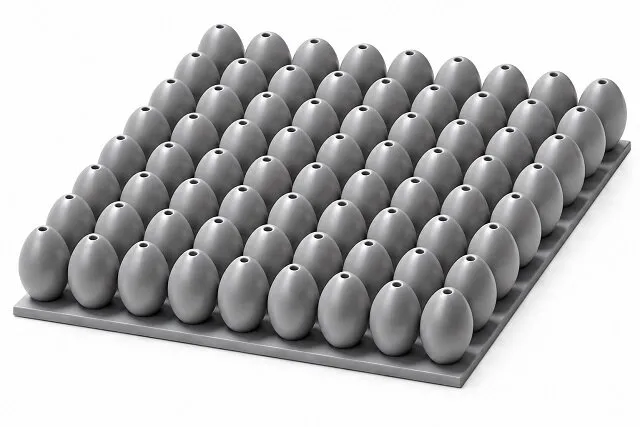
The study combined computational modeling, 3D-printed structures and laboratory impact simulations. The researchers designed egg-shaped aluminum shells filled with water and arranged them systematically between two aluminum impact plates, with the wider ends facing downward. Their performance was then compared with that of conventional aluminum plates and water-filled aluminum spheres positioned between two plates.
The tests showed that the water-filled, eggshell-inspired aluminum structure provided the strongest protective performance among the configurations examined. The structure was able to withstand substantial loads while reducing the velocity of an incoming projectile by nearly 65 percent. By comparison, conventional aluminum plates without the internal eggshell-like architecture reduced projectile velocity by approximately 51 percent.
The researchers also found that the orientation of the shells played an important role. Metastructures in which the eggs were positioned upright, with their narrower ends facing and contacting the upper plate, delivered the highest level of protection. In this configuration, impact energy was distributed through the structure rather than concentrated at a single point. The shells progressively collapsed and deformed in sequence, helping dissipate the destructive force of the impact.
At first glance, using a structure modeled on a fragile eggshell to enhance protection may seem counterintuitive. However, the defensive mechanism of the interconnected architecture is fundamentally different from that of an individual egg. While a single eggshell can fracture under a concentrated load, the coordinated, sequential deformation of multiple shell-like units transforms the impact load into widespread energy dissipation throughout the structure.
Water inside the shells also appears to play a critical role. During a high-speed impact, the water undergoes intense fluid motion, helping limit the propagation of shock waves. The dynamic interaction between the water and the aluminum shells therefore contributes to absorbing and dispersing a substantial portion of the impact energy.
The researchers emphasize, however, that further optimization and testing will be necessary before the material can be considered for practical use as a lightweight spacecraft shield. The team is currently refining factors such as shell thickness, dimensional ratios and structural arrangement to further enhance energy absorption.
The findings suggest that lightweight, bio-inspired metastructures could offer a promising new strategy for protecting spacecraft from hypervelocity impacts. More broadly, the study highlights how structural principles found in nature can inspire innovative engineering solutions to some of the most demanding challenges facing future space missions.


















