New Lollipop Sensor Detects Medication Through Saliva
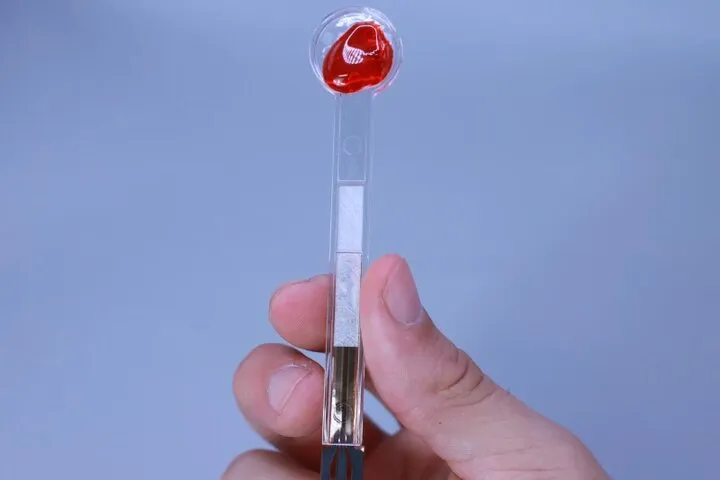
A red, peach-flavoured candy coating on the Lollylab device stimulates saliva production, while a sensor embedded at its tip analyses the sample for the presence of acetaminophen.
Saliva can provide valuable information about human health. Scientists can even use it to detect signs of heart failure. However, medical tests, including something as simple as collecting a saliva sample, can be unpleasant, particularly for children.
Researchers at the University of Southern California have now developed an approach that could make medical testing a more enjoyable experience.
Lollylab is a lollipop-inspired device that incorporates a miniature laboratory. It consists of two connected plastic components, each featuring a handle and a rounded tip. The rounded head contains small openings, while the handle is made of fibreglass covered with a paper layer. Saliva enters through the openings, travels along the handle and reaches a graphene-based sensor at the end of the device in approximately 60 seconds.
The miniature laboratory is designed to detect acetaminophen, an active ingredient found in many painkillers and cold and flu medications. Although acetaminophen-containing medicines are available over the counter, excessive consumption can cause serious side effects, including liver damage. Accidental dosing errors can also pose significant risks, particularly for children.
Another reason the researchers selected acetaminophen is that its concentration in saliva can closely reflect its level in the bloodstream. This makes it possible to detect and monitor the drug without drawing blood. The test also requires only a small amount of saliva, approximately 0.3 millilitres, or about six drops.
One of Lollylab's most distinctive features is its rounded tip, which is coated with red, peach-flavoured candy. While this may appear to be an additional feature, it serves an important practical purpose: giving the device a familiar, child-friendly appearance and allowing children to provide saliva samples simply by licking it.
The device uses an electrode made from laser-induced graphene to detect the drug. This material is already widely used in wearable health-monitoring devices, environmental sensors and water purification systems.
When saliva containing acetaminophen reaches the electrode's surface, it triggers a chemical reaction that generates an electrical signal. The sensor measures this signal to determine the presence of the drug.
The researchers tested Lollylab using both artificial and human saliva. The human study was relatively small, involving six adults who took acetaminophen and provided samples by licking the device. Lollylab detected the drug in less than two minutes.
Participants also reported that the method was considerably easier and more comfortable than collecting saliva using conventional swabs.
Despite these promising findings, the technology remains at an early stage of development, and Lollylab is currently an experimental prototype.
The researchers plan to conduct larger studies and adapt the technology to detect other substances in saliva.
If successfully developed, the device could change the way medical testing is approached. Adults, too, may be just as excited as children about this innovation, even if they are less likely to admit it.