Robots: How They Work, Their Types and Uses in Everyday Life
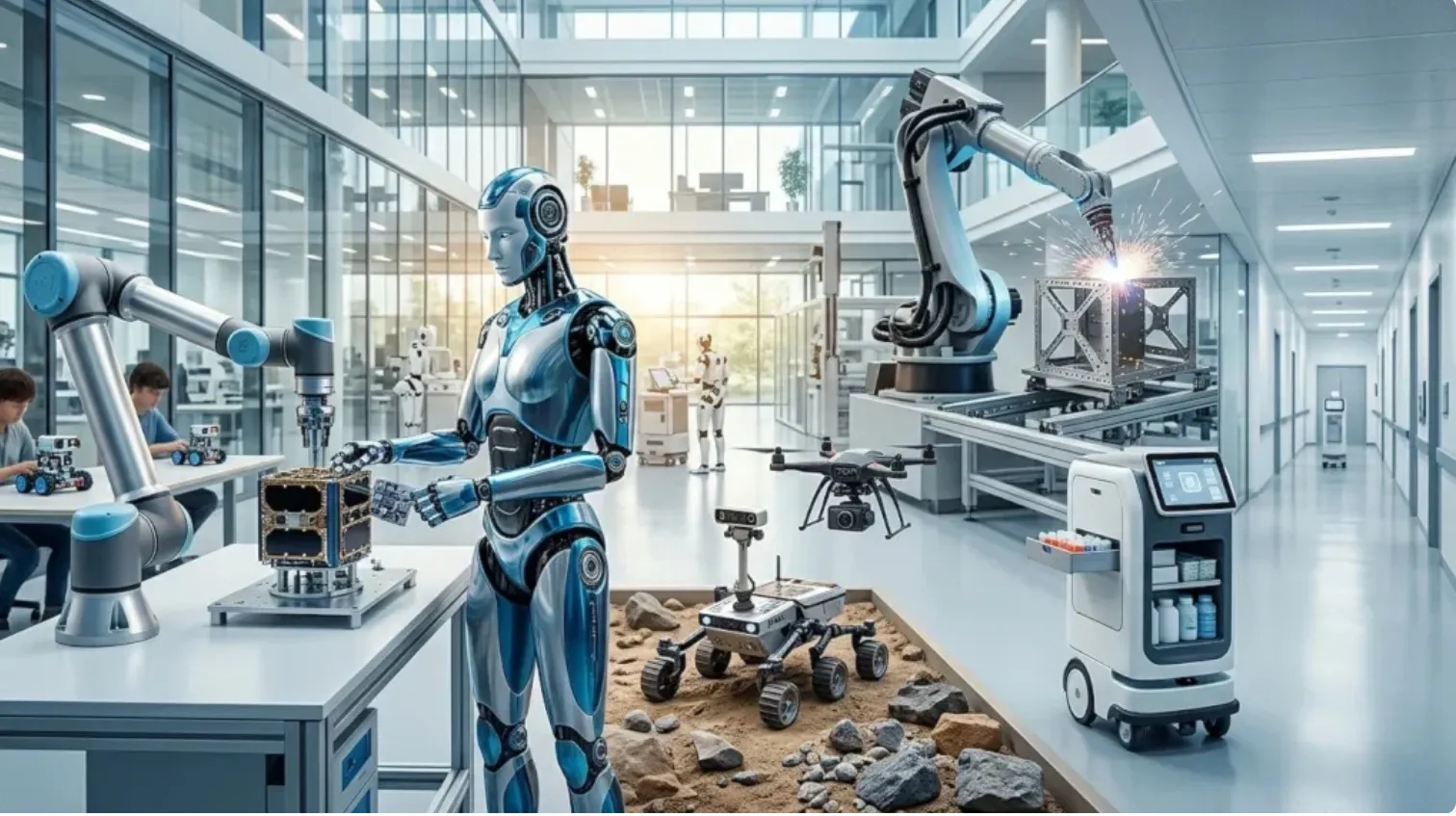
An industrial robotic arm welds car parts on an assembly line, while a robotic vacuum cleaner moves between pieces of furniture to clean the floor. The two machines differ in appearance and function, but they share a fundamental principle: both are programmable and use control systems to perform physical tasks. This principle helps explain what robots do in factories, homes and hospitals, and why some require a human operator while others can carry out specific tasks autonomously.
What Are Smart Robots?
Robots are programmable machines designed to perform physical tasks, such as moving a tool, handling an object or navigating an environment. Depending on their intended purpose, they can take the form of a fixed arm, a small mobile vehicle or a human-like machine.
What Makes a Robot Different?
A simple automated machine repeats a fixed operating cycle. A robot's control system, however, can be programmed to coordinate multiple movements and may use sensor data to adjust its actions while performing a task.
For example, on a packaging line, a robotic arm can adjust its gripping position according to where a container is located on the conveyor belt, provided the variation falls within the system's designed operating limits.
A Brief History of Smart Robots
Programmable robotic arms marked a major milestone in the history of robotics when they were introduced into automobile production lines in the 1960s.
Applications expanded as sensors, computing and control technologies advanced, leading to the development of platforms capable of moving around warehouses and homes. The Institute of Electrical and Electronics Engineers (IEEE) provides an overview of robotics history and its design principles.
How Do Robots Work?
The components of a robot can be understood by following a familiar task. When a robotic vacuum cleaner approaches an obstacle, its sensors detect the object, the control system processes the signal, and the motors are instructed to change direction. This process is repeated as the robot continues moving.
Sensors and Control Systems
Sensors measure the information a robot needs to perform its task, such as the distance to an object, the position of a joint or the amount of force exerted by a tool.
The controller uses these readings to determine the next movement according to its programmed instructions. If the actual position differs from the intended one, the system can use the measurements to correct the movement. This process is known as feedback.
Motors and Moving Components
Motors or actuators convert control commands into physical movement. They may turn wheels, move the joints of a robotic arm or open and close a gripper around an object.
The choice of components depends on the task. A gripper designed to handle lightweight containers requires different characteristics from an arm intended to lift heavy metal parts.
What Are the Different Types of Robots?
Robots can be classified according to their applications, physical structure, mobility and level of autonomy. A single device may belong to more than one category. For example, a robot that transports supplies around a hospital is both a service robot and a mobile robot, and it may operate autonomously along predefined routes.
Classification by Task and Working Environment
Industrial robots: Perform welding, painting, assembly and material-handling operations on production lines.
Medical robots: Assist with surgery, rehabilitation and the transportation of supplies within healthcare facilities.
Educational and domestic robots: Provide hands-on experience in programming and control or perform household tasks such as floor cleaning.
Military robots: Include remotely operated platforms used to inspect hazardous objects and keep people away from dangerous locations.
Classification by Shape, Mobility and Autonomy
The term "mobile" describes a robot's ability to move from one location to another, while "autonomous" refers to how much it can accomplish without continuous human intervention.
The term "humanoid" describes a robot's human-like appearance, whereas collaborative robots are designed to work alongside people under specific operating conditions.
The International Federation of Robotics (IFR) explains the different types of industrial robotic arms and their collaborative applications.
Where Are Robots Used?
The application determines how much human intervention is required. An industrial robotic arm may complete an entire operating cycle once configured, whereas a surgeon guides the instruments in robot-assisted surgical systems.
Industry, Medicine and Logistics
In factories, industrial robots repeatedly perform operations such as welding and material handling.
In warehouses, mobile platforms can transport loads between storage and order-preparation areas, while human workers deal with situations that fall outside normal operating procedures.
In surgery, some systems translate a surgeon's movements into precise instrument movements. Al Mayadeen has also reported on technology designed to control the gripping force applied to human tissue.
Homes, Education and Space Exploration
At home, a robotic vacuum cleaner navigates around obstacles such as furniture within the limits of its design.
In the classroom, students can modify the programme of a small robot and observe how those changes affect its movement.
In space exploration, robotic platforms help capture images of difficult-to-reach terrain and collect measurements. Depending on the task, operational responsibilities are shared between onboard software and the teams supervising the mission.
What Is the Relationship Between Robotics and Artificial Intelligence?
Automation refers to carrying out a process automatically, whether through software or machinery. A robot is a device that performs physical actions, while artificial intelligence can provide additional capabilities, such as recognising or classifying objects.
AI can also be used in software applications that operate independently of any robot.
Predefined Programming and Automation
An industrial robotic arm may repeat a welding movement according to coordinates previously programmed by a technician.
The control system regulates joint movements based on the programme and sensor measurements. This task can be performed without using a machine-learning model.
Computer Vision and Machine Learning
When different objects are mixed together on a sorting conveyor belt, robots may use computer vision systems to identify the target object and estimate its position.
A machine-learning model can assist with classification. However, the accuracy of the results remains dependent on operating conditions, including lighting, the diversity of objects and how well the training data represents real-world situations.
Advantages and Disadvantages of Robots
The value of robotics depends on how well a system is suited to its intended task and whether the operating organisation can maintain it and monitor its performance.
Its main benefits may include improving product quality, reducing physical workloads or limiting people's exposure to hazardous conditions.
Precision, Productivity and Reduced Exposure to Hazards
Robots can repeat handling and assembly movements under controlled conditions. Consistent movements may reduce variations between manufactured products, while automated material handling can ease some physical demands on workers.
Remotely operated devices also make it possible to inspect locations that are difficult to access directly.
Costs, Maintenance, Safety and Accountability
The overall cost includes purchasing the equipment, integrating it into the workplace, training operators and carrying out maintenance.
A malfunctioning sensor or software error can disrupt an entire stage of production.
Network-connected robots also require protection for their control systems and data. Meanwhile, robots operating alongside people require risk assessments and clear procedures defining who has the authority to stop operations and investigate incidents.
How Do Robots Affect the Labour Market?
The impact of robotics initially becomes apparent in the individual tasks that make up a job.
A machine may take over the task of moving boxes around a warehouse, while a worker continues inspecting goods and handling unusual shipments. The effect on employment levels depends on how widely automation is adopted and how work is organised.
Changes in Job Responsibilities
Repetitive tasks are relatively easy to automate when their steps are clearly defined and the working environment is controlled.
However, dealing with unexpected situations, such as damaged packaging or orders requiring additional review, may remain the responsibility of human workers.
Their roles may therefore increasingly involve monitoring systems and intervening when necessary.
Training and New Skills
Operating robots creates demand for skills such as programming, sensor calibration and fault diagnosis.
Professional retraining can help workers move into these roles, particularly when training is linked to the equipment and procedures they actually use.
What Is the Future of Robotics?
Collaborative robots are already being used in some industrial environments, while mobile platforms are performing internal transportation tasks.
One area of research focuses on expanding the range of tasks these devices can perform when working conditions change or new obstacles emerge.
Autonomous Applications and Human-Robot Collaboration
Advances in sensing and control technologies could expand the use of robots in handling different types of objects in factories and transporting supplies within healthcare facilities.
Moving from research prototypes to everyday applications depends on testing performance under real-world conditions and identifying situations that require human intervention.
Privacy and Human Oversight
When robots use cameras or collect data in places frequented by people, decisions about data storage and access become an important part of their deployment.
Human oversight becomes even more important when a movement error could injure someone or when a situation requires judgement beyond the limits of a programmed task.
Ultimately, a robot's value is measured by its ability to perform a specific task safely and reliably in its intended environment. Before introducing robots into a factory, hospital or home, the first step is to identify the required task, assess operating costs and autonomy limits, and determine who can intervene if the process does not go as planned.