NASA Identifies First Confirmed Starless Object Dominated by Dark Matter
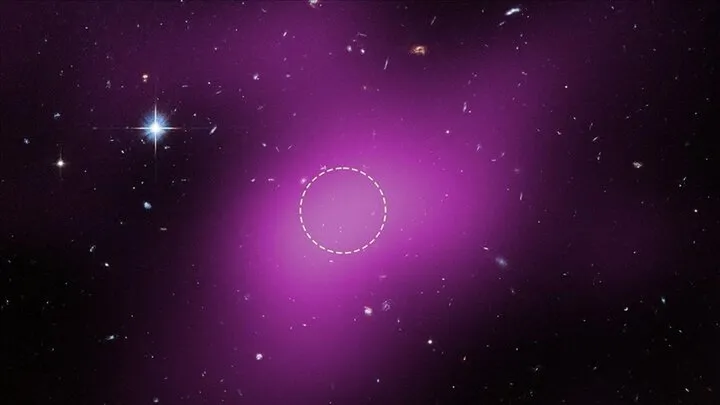
The discovery, announced Monday on NASA’s official website, is based on observations from the Hubble Space Telescope and focuses on an unusual object known as “Cloud-9,” located near the spiral galaxy Messier 94. Researchers describe the object as rich in gas but entirely lacking stars, making it a rare and compelling case study.
Alejandro Benitez-Llambay of the University of Milano-Bicocca, the study’s principal investigator, said the absence of stars is central to the finding, characterizing Cloud-9 as a “failed galaxy.” He noted that scientific progress often comes from understanding what does not work, rather than what does.
Andrew Fox of AURA/STScI, a member of the research team, described the object as a unique opportunity to observe the dark universe directly. Because dark matter does not emit light, such starless clouds provide rare observational access to its effects.
Follow-up imaging using Hubble’s Advanced Camera for Surveys confirmed that Cloud-9 contains no stars. Lead author Gagandeep Anand of the Space Telescope Science Institute said the data conclusively show the absence of any stellar population within the cloud.
The findings were published in The Astrophysical Journal Letters and presented at the 247th meeting of the American Astronomical Society in Phoenix. According to NASA, the discovery lends strong support to long-standing theories predicting the existence of primordial “failed galaxies” and opens new avenues for studying the dark matter that shaped the early universe.