Astronomers Find Universe’s ‘Missing’ Matter
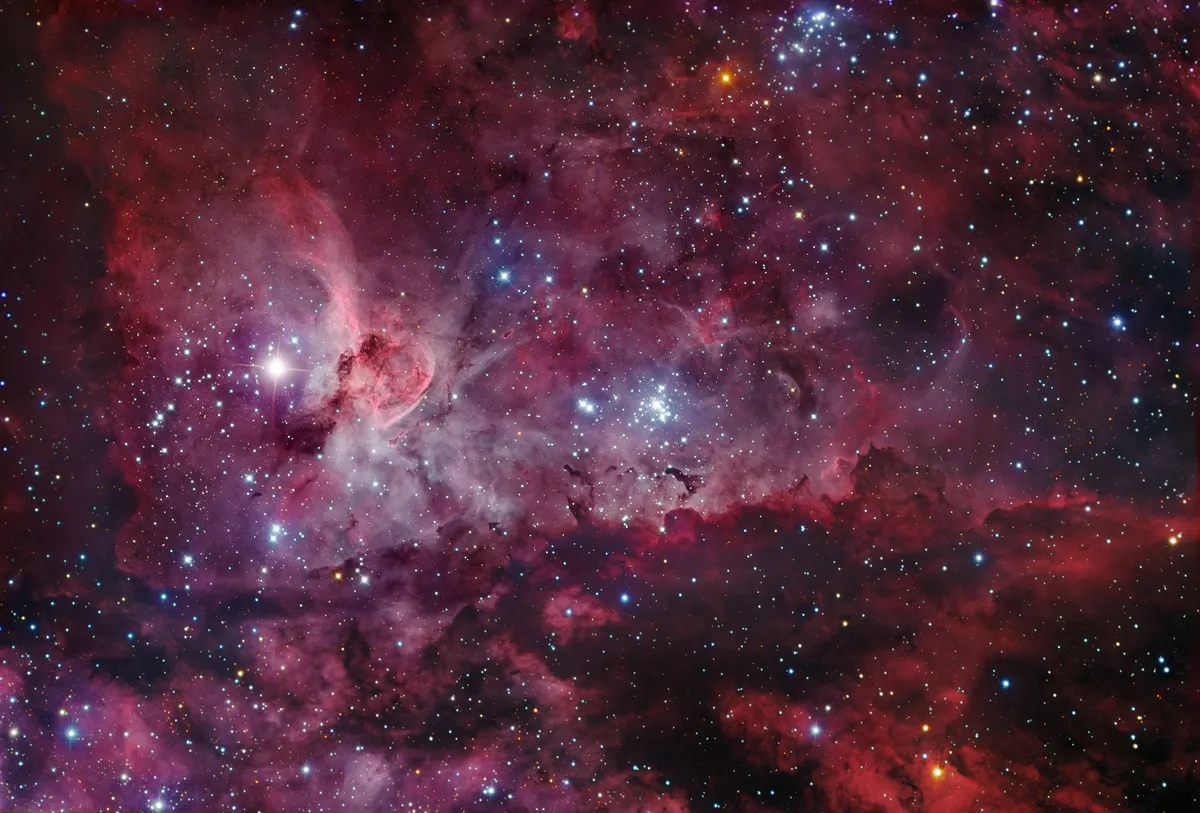
Astronomers have identified a massive filament of hot gas connecting four galaxy clusters. With a mass roughly ten times greater than that of the Milky Way, this structure could contain some of the Universe’s long-missing matter, helping to resolve a decades-old cosmic mystery, the journal Astronomy & Astrophysics reported.
The discovery was made using data from the European Space Agency’s XMM-Newton and Japan’s Suzaku X-ray space telescopes.
More than one-third of the ‘normal’ matter in the nearby Universe—the kind that forms stars, planets, galaxies, and life—has yet to be observed directly. Despite being essential to our current models of the cosmos, this matter has remained hidden.
The leading explanation is that it resides in diffuse, thread-like structures of gas called filaments, which span the densest regions of space. Although filaments have been detected before, their faint emissions make it difficult to separate their light from nearby sources like galaxies and black holes.
Now, new research is among the first to overcome that challenge, successfully detecting and precisely characterizing a single hot gas filament connecting four galaxy clusters in the nearby Universe.
“For the first time, our results closely match what we see in our leading model of the cosmos – something that’s not happened before,” says lead researcher Konstantinos Migkas of Leiden Observatory in the Netherlands. “It seems that the simulations were right all along.”
With a temperature exceeding 10 million degrees, the filament holds about ten times the mass of the Milky Way and links four galaxy clusters—two at each end. These clusters belong to the Shapley Supercluster, a vast assembly of over 8,000 galaxies and one of the most massive structures in the nearby Universe.
The filament extends diagonally through the supercluster for 23 million light-years, a distance equal to crossing the Milky Way from end to end approximately 230 times.
Konstantinos and colleagues characterized the filament by combining X-ray observations from XMM-Newton and Suzaku, and digging into optical data from several others.
The two X-ray telescopes were ideal partners. Suzaku mapped the filament’s faint X-ray light over a wide region of space, while XMM-Newton pinpointed very precisely contaminating sources of X-rays – namely, supermassive black holes – lying within the filament.
“Thanks to XMM-Newton we could identify and remove these cosmic contaminants, so we knew we were looking at the gas in the filament and nothing else,” adds co-author Florian Pacaud of the University of Bonn, Germany. “Our approach was really successful, and reveals that the filament is exactly as we’d expect from our best large-scale simulations of the Universe.”
As well as revealing a huge and previously unseen thread of matter running through the nearby cosmos, the finding shows how some of the densest and most extreme structures in the Universe – galaxy clusters – are connected over colossal distances.
It also sheds light on the very nature of the ‘cosmic web’, the vast, invisible cobweb of filaments that underpins the structure of everything we see around us.
“This research is a great example of collaboration between telescopes, and creates a new benchmark for how to spot the light coming from the faint filaments of the cosmic web,” adds Norbert Schartel, ESA XMM-Newton Project Scientist.
“More fundamentally, it reinforces our standard model of the cosmos and validates decades of simulations: it seems that the ‘missing’ matter may truly be lurking in hard-to-see threads woven across the Universe.”
Piecing together an accurate picture of the cosmic web is the domain of ESA’s Euclid mission. Launched in 2023, Euclid is exploring this web’s structure and history. The mission is also digging deep into the nature of dark matter and energy – neither of which have ever been observed, despite accounting for a whopping 95% of the Universe – and working with other dark Universe detectives to solve some of the biggest and longest-standing cosmic mysteries.
4155/v