China Expands Space Launch Infrastructure to Support Booming Commercial Sector
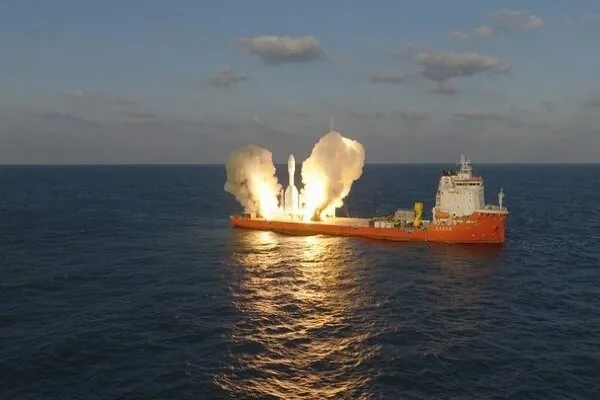
China is accelerating efforts to expand its space launch capabilities as commercial satellite networks and private rocket companies drive demand for more frequent and flexible launches. New infrastructure, ranging from sea-based launch platforms to specialized rocket facilities, is helping broaden access to space across the country.
A recent example came in September, when a commercial rocket carrying nine satellites launched from a vessel in the East China Sea near Shanghai. Although the densely populated economic center lacks a conventional rocket launch site, offshore launches provide a direct link to China's rapidly expanding space industry.
China conducted its first sea-based rocket launch in 2019 off the coast of Haiyang, a city in eastern Shandong Province. Since then, Haiyang has developed a spaceport equipped to support rocket assembly, testing and launch operations. According to Teng Yao, the facility's chief engineer, launching from the sea offers greater flexibility in selecting launch locations and flight trajectories while allowing rocket debris to fall into uninhabited waters.
Wenchang, in southern China's Hainan Province, has also expanded its launch infrastructure. The site, known for supporting missions involving space station modules and lunar probes, has added facilities dedicated to commercial rocket and satellite launches since 2024.
Elsewhere, the Dongfeng commercial space innovation pilot zone, located near the Jiuquan Satellite Launch Center in northwest China, has established launch facilities specifically designed for private rocket manufacturers.
Launch Capacity Emerges as a Bottleneck
Access to launch facilities has become a major challenge for China's commercial space industry. Wang Lifeng, a professor at Nanjing University of Aeronautics and Astronautics, identified limited launch capacity, crowded schedules and long distances between launch sites and rocket assembly facilities as key obstacles to further growth.
The deployment of large satellite constellations is adding to the pressure. China's Qianfan, also known as Spacesail, and GW satellite networks are each planned to comprise more than 10,000 satellites, creating demand for a sustained pace of launches.
To address this need, Wenchang's commercial spacecraft launch site has brought its first two launch pads into regular operation. The second pad can accommodate more than 20 types of rockets and can be prepared for another launch within 66 hours.
Two additional pads, part of the site's second development phase, are scheduled to enter service by the end of the year. Once fully operational, the commercial launch site is expected to support approximately 60 launches annually.
Sea-Based Operations Cut Logistics Costs
Haiyang is pursuing a different approach to improving launch efficiency by bringing key stages of rocket preparation closer together.
Peng Haomin, co-founder of private rocket manufacturer Orienspace, said the company's facilities are concentrated within Haiyang's spaceport, enabling rockets to be assembled, tested and transported onto a launch vessel within a distance of just 5 kilometers.
“This has replaced usual transportation over more than 1,000 km, drastically cutting logistics time and cost,” Peng said.
Purpose-built launch facilities are also helping private companies accelerate their operations. Meng Xiangfu, deputy chief commander of the Lijian-1 rocket developed by commercial space company CAS Space, said the company's dedicated launch pad and technical infrastructure at the Dongfeng commercial space innovation pilot zone allow it to complete rocket testing and launch preparations in 10 days.
Regional Space Hubs Attract Investment
The expansion of launch infrastructure is generating investment and supporting the development of regional commercial space clusters.
Haiyang has attracted 33.5 billion yuan, equivalent to approximately $5 billion, in related investment and has secured more than 30 aerospace projects. Wenchang's space industry park is home to more than 700 companies.
Shanghai, meanwhile, is developing a terminal linked to commercial spaceport operations, designed to connect rocket assembly activities with port logistics and offshore launch services.
These initiatives reflect a broader international push to strengthen space infrastructure as the commercial space sector grows. The United States is seeking to expand its space transportation capabilities, while Russia has called for improvements to its industrial base and ground-based space infrastructure.
National Policy Supports Commercial Launch Development
China's infrastructure expansion is also backed by national policy. An action plan issued by the China National Space Administration for 2025–2027 calls for the coordinated development of commercial launch sites and supports new commercial launch systems, including sea-based launch and recovery facilities.
At the same time, China is advancing the development of heavy-lift and reusable launch vehicles to increase launch capacity and improve cost efficiency.
Analysts say the effective operation of these new facilities could give China's commercial space industry the capacity, flexibility and operational efficiency needed to sustain its expansion and meet growing demand for satellite launches.