New Method Achieves 98.3% Efficiency in Cell Separation
Researchers from the university's Faculty of Mechanical Engineering have developed and evaluated a novel system for the controlled movement and selective separation of particles and cells using magnetic microfluidics. The findings have been published in Scientific Reports, a journal within the Nature Portfolio.
The study was conducted by Roozbeh Abedini-Nassab, a faculty member at the Faculty of Mechanical Engineering; Atabak Mohammadi Moazad, a master's student at the same faculty; and Yaping Dan from Shanghai Jiao Tong University in China.
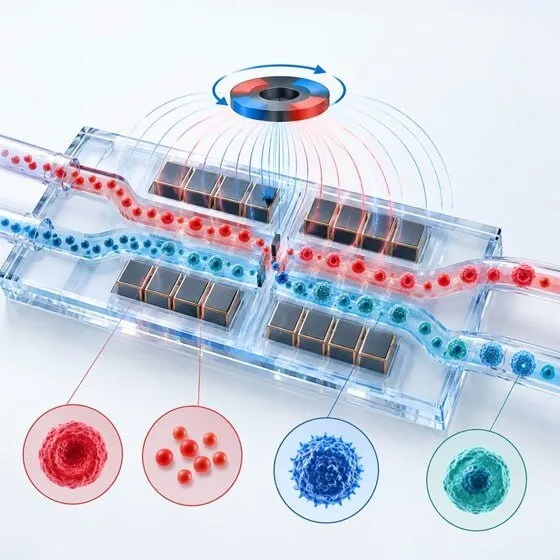
In this research, the team designed and tested a microfluidic system based on magnetophoresis. By employing microscale magnetic structures and applying a rotating magnetic field, the system enables precise control over the movement of magnetically labeled particles and cells.
The main innovation lies in the use of a microscale gap along the magnetic pathway, which acts as a magnetic energy barrier. Whether particles can pass through this gap depends on factors such as their size, effective magnetic moment and the characteristics of the applied magnetic field. By adjusting the magnetic field parameters, researchers can control the passage of different particles and cells, enabling their selective separation.
To evaluate the system's performance, the researchers used numerical modeling, experimental tests and machine learning techniques. The results showed that machine learning models could predict whether particles would pass through the gap with an accuracy of up to 95%.
The system also achieved approximately 96% efficiency in size-based particle separation and around 98% efficiency in separating HEK-293T cells with different levels of magnetic loading. In an experiment involving a mixed population of T cells and HEK-293T cells, the separation efficiency reached 98.33%.
The research was conducted under project No. 4030741, with support from the Iran National Science Foundation (INSF). The international scientific collaboration also involved Shanghai Jiao Tong University in China as part of an international research partnership.
The findings could pave the way for advances in lab-on-a-chip technologies, single-cell analysis and biomedical diagnostic devices, where precise and controlled cell separation is essential.