DNA–protein Hydrogels could enable adaptive smart materials
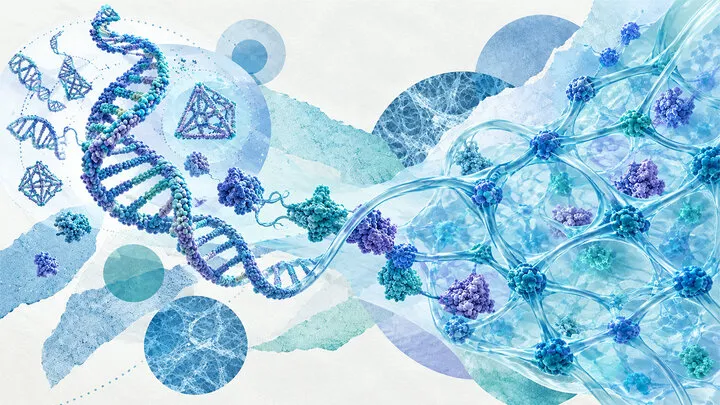
A Perspective article accepted for publication in Science Bulletin examines the potential of DNA–protein hydrogels to bridge molecular information and material behavior.
DNA technology has moved beyond its traditional roles in storing and transmitting genetic information. It has become a powerful tool for building programmable molecular materials and systems.
Through specific base pairing, researchers can design DNA strands to form structures with nanometer-scale precision. These structures can also organize proteins, nanoparticles, ligands and other functional components at defined locations.
However, transferring this level of control from individual nanoscale structures to large, three-dimensional materials remains a major challenge.
The article, titled “Programmable DNA–protein hydrogels: From structural DNA nanotechnology to adaptive soft matter,” examines this challenge and the emerging capabilities of DNA–protein hydrogels.
The researchers show how DNA sequence, network architecture and protein components can work together to generate complex properties. These include viscoelastic behavior, molecular recognition, catalytic activity, environmental responsiveness and dynamic adaptation.
Extending programmable DNA nanostructures
DNA hydrogels can be viewed as an extension of programmable DNA nanostructures into interconnected and dynamic networks.
In these materials, overall performance depends on more than the structure of individual molecules. Network topology, the formation and breakdown of crosslinks, molecular density and the diffusion of molecules through the network all play important roles.
As a result, changing a DNA sequence or its interaction with other components can ultimately alter the mechanical and functional properties of the entire hydrogel.
Functional DNA sequences such as aptamers can provide specific recognition of target molecules. Proteins can add other capabilities, including catalytic activity, signal transduction and regulation of biological reactions.
DNA–protein hydrogels can therefore function as more than molecular scaffolds. They can act as dynamic materials in which information encoded in DNA sequences is translated into collective behavior across the network.
Researchers have investigated such systems for selective capture of exosomes, enhanced intracellular catalysis, enzyme stabilization and the formation of reversible biological compartments.
These examples suggest that DNA hydrogels can simultaneously serve as structural materials, sensors, reaction environments and responsive systems.
From molecular design to material behavior
A key challenge in this field is understanding the multilevel relationship between molecular design and the final properties of a material.
Sequence-dependent DNA hybridization determines how strands fold, connect and form or break crosslinks. These molecular events then shape network properties such as crosslink density, pore size, topology, heterogeneity and molecular transport pathways.
These factors directly affect stiffness, swelling, molecular release, protein accessibility and stress relaxation.
Several approaches have been developed to construct these networks. They include four-way junction assembly, hairpin-based clamped hybridization chain reaction and rolling circle amplification (RCA).
Each approach produces a different network architecture and can therefore result in different mechanical and functional properties.
Proteins can also be incorporated into the networks in several ways.
Physical encapsulation is a relatively simple method for loading proteins, but it offers limited control over their spatial position. Hybridization-based assembly and bioorthogonal conjugation provide greater control over protein organization. However, the chemical modifications required for these approaches can affect protein activity.
Aptamer-based interactions and specific binding mechanisms can enable selective and even reversible protein attachment. Their performance, however, depends on factors such as binding strength, target accessibility and the structure of the surrounding network.
A two-way interaction between DNA and proteins
The relationship between DNA and proteins is not one-way.
DNA architecture can affect protein encapsulation, diffusion, accessibility and local concentration. At the same time, proteins can alter the organization and dynamics of the DNA network.
This two-way interaction can produce collective behaviors such as cooperative recognition, catalytic amplification and responses to environmental stimuli.
It also makes the final behavior of these systems more difficult to predict. Biological activity does not depend on a single molecular interaction but is also influenced by the changing environment within the hydrogel.
When molecular changes become mechanical responses
Studies of DNA–protein hydrogels show that changes in molecular design can alter the mechanical behavior of a material by changing network formation and dynamics.
For example, the DyNAtrix platform uses reversible, sequence-specific crosslinks to translate the dynamics of DNA hybridization into controlled changes in stress relaxation and adaptive mechanical responses.
Studies using rolling circle amplification have also shown that the template sequence, formation of secondary structures, amplification efficiency, amount of DNA produced and reaction conditions can affect hydrogel mechanics.
These findings highlight a fundamental principle of programmable biomaterials: a molecular-level change can pass through several intermediate stages and ultimately produce a measurable change in the behavior of a material at a larger scale.
The challenge of predictive modeling
Developing a reliable predictive model for this relationship remains difficult.
Once DNA strands become part of a heterogeneous and continuously changing network, multiple factors influence performance at the same time. These include sequence-dependent hybridization, structural organization, network topology, crosslink density and dynamics, molecular crowding, diffusion and even the history of network formation.
Future models will therefore need to connect DNA sequences and molecular interactions with intermediate network properties. They must then link those properties to the overall mechanical and functional behavior of the hydrogel.
Chromatin as a natural model for dynamic organization
The researchers also point to chromatin as a natural example of dynamic organization in DNA–protein systems.
Chromatin involves interactions among DNA, proteins, biochemical modifications and nonequilibrium processes across multiple scales. Although chromatin is not a conventional DNA–protein hydrogel, its dynamic organization may provide clues for combining molecular information with adaptive physical properties in synthetic biomaterials.
Advances in reversible DNA-based molecular encapsulation and the development of materials linked to biological processes have further expanded the potential of these systems.
In such materials, molecular recognition, biological reactions, information processing and time-dependent changes could be integrated within a soft and dynamic network.
A central question for DNA–protein hydrogels
Despite these advances, one fundamental question remains: How can information programmed into a DNA sequence be reliably converted into a specific property at the material scale?
Answering this question will require models that connect multiple levels of organization, from DNA sequences and molecular interactions to network architecture and, ultimately, the mechanical and biological behavior of the material.
If this challenge can be addressed, DNA–protein hydrogels could evolve from programmable structures into a new class of adaptive soft materials. Such materials could not only respond to environmental stimuli but also alter their network behavior based on molecular information encoded within their structure.
For now, however, fully autonomous self-organization and adaptation remain largely research goals rather than established capabilities. Progress will depend on more precise control of network architecture, better predictive models and a clearer link between molecular design and large-scale material function.