AI Helps Turn Bacteria into Biological “Transistors”
An Iranian postdoctoral researcher, Hamid Doust-Hosseini, and colleagues at the Massachusetts Institute of Technology (MIT) have engineered bacterial cells to work similarly to electronic transistors, a development that could enable the creation of sophisticated synthetic biological circuits.
Doust-Hosseini, the study’s lead researcher, said the team had developed key components for biological computing, potentially opening the door to new applications in biological circuitry.
The researchers hope the technology could eventually be used to create circuits that can be placed on plant leaves or roots to monitor environmental conditions such as drought or pest attacks and respond through biological computations.
Engineering bacterial cells
Rather than building an entire biological circuit inside a single cell, the researchers engineered individual bacterial cells to function as transistors. This approach allows the transistors to be assembled in different configurations to create increasingly complex circuits.
The team used Pantoea agglomerans, a bacterium that naturally grows on a variety of surfaces, including plants. They developed two types of genetically engineered transistors that can be switched on and off by the molecule OC-6.
Each transistor can detect the presence of a target molecule and send a signal to the next component of the circuit, allowing bacterial cells to be connected to perform multiple biological functions.
The researchers also used three strains of Pantoea agglomerans as biological “relays” that convert an OHC-14 signal into an output capable of activating another transistor. These relay strains allowed the scientists to connect the bacterial transistors in much the same way electronic components are linked on a circuit board.
For example, the team built a two-way switch using two transistors that detect the presence of OC-12. The transistors then transmit the information to different relay strains depending on the switch's control inputs, ultimately sending the signal to other transistors for further processing.
How the biological transistors work
Unlike conventional transistors, which regulate the flow of electrical current, the bacterial transistors control the movement of small signaling molecules such as OC-6 and OC-12.
In one type of transistor, a genetically modified bacterial strain becomes active when a target molecule is detected, while the corresponding type switches off. The relay cells then transmit chemical signals in a single direction between different bacterial colonies.
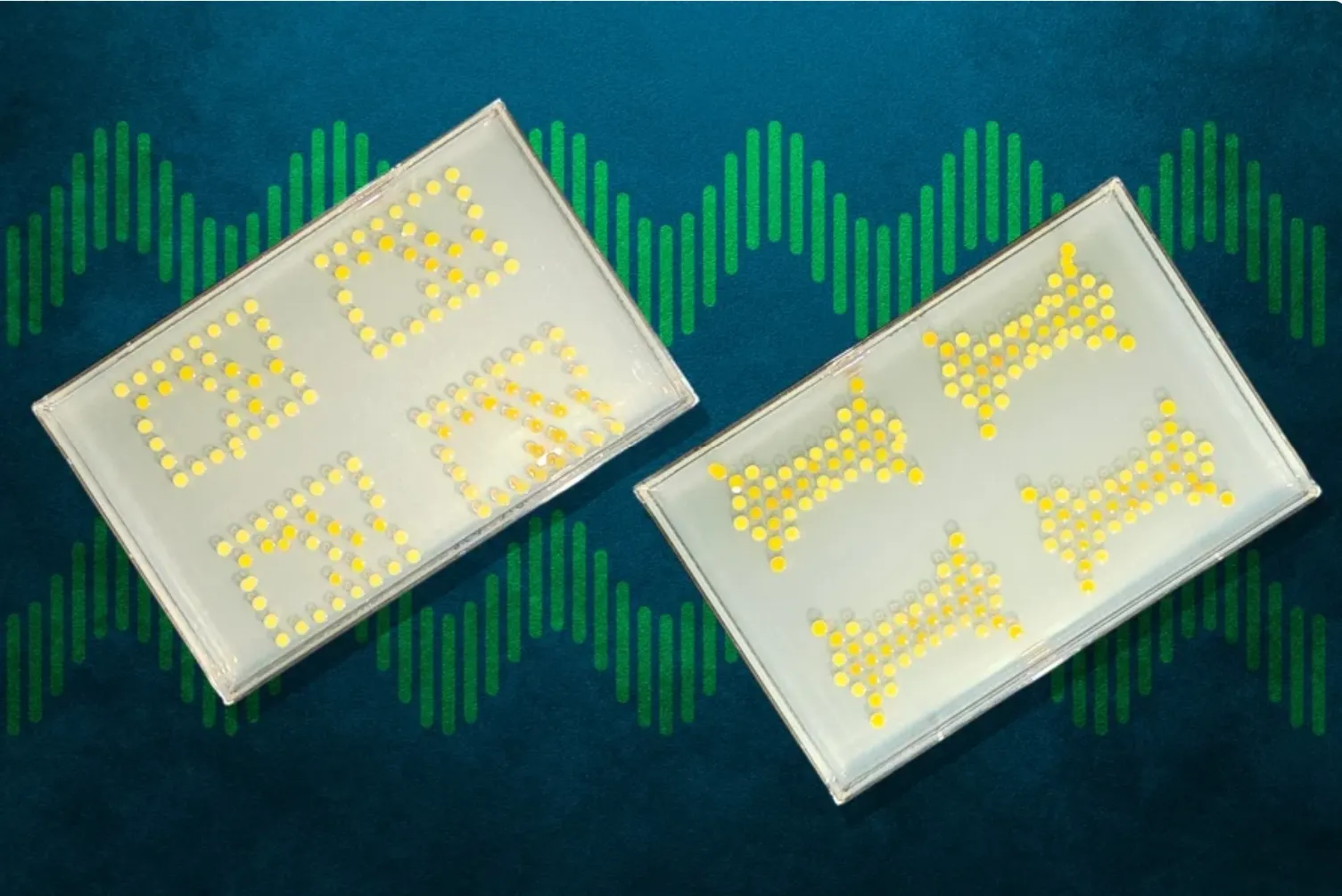
The system also has a modular design: by changing the spatial arrangement of just five basic bacterial strains on a growth plate, researchers can alter the computation performed by the circuit without having to genetically engineer new strains.
To construct the circuits, the researchers printed bacterial colonies onto agar plates, a nutrient-rich medium used to grow bacteria. Each colony was positioned approximately 5 millimeters from its nearest neighbor.
This spacing ensures that signals are transmitted primarily to the closest colony, which then passes the signal to the next one, allowing information to flow in a controlled, one-way direction.
The researchers believe the technology could eventually lead to biological systems capable of performing computations inside living organisms, with potential applications in monitoring environmental changes and responding to them autonomously.