Trained Dogs Detect Parkinson’s with 98 Percent Accuracy
In a double-blind study involving over 200 samples, these scent-detection dogs distinguished people with Parkinson’s from healthy individuals and those with other conditions. The results suggest that Parkinson’s has a unique scent signature, and dogs could help pioneer a faster, non-invasive way to detect the disease years earlier than current methods allow, the Journal of Parkinson’s Disease reported.
A new study has found that trained dogs can reliably identify people with Parkinson’s disease (PD) by scent alone, using skin swabs.
The research, published July 15 in The Journal of Parkinson’s Disease, was conducted in partnership with the charity Medical Detection Dogs and researchers from the Universities of Bristol and Manchester.
As part of the study, two dogs were specifically trained to recognize the difference in smell between skin oil (sebum) samples from individuals with Parkinson’s and those without.
In a double-blind trial, where neither the handlers nor researchers knew which samples were which, the dogs achieved up to 80% sensitivity and up to 98% specificity in detecting the disease.
Remarkably, the dogs were still able to identify Parkinson’s even when the samples came from individuals with additional health conditions.
The training involved more than 200 scent samples collected from both Parkinson’s patients and healthy controls. These were presented on a specialized sample stand. The dogs were rewarded when they correctly identified a positive sample or accurately ignored a negative one.
In the double-blind testing, meaning that only a computer knew where the correct samples were, each line was also presented in reverse order so that samples for which no decision was made were re-presented. Then any unsearched samples were collected together in new lines, until a decision had been made for all samples.
A definitive diagnostic test for Parkinson’s Disease (PD) remains elusive, so identification of potential biomarkers could help diagnosis and timely intervention.
Claire Guest, Medical Detection Dogs CEO and Chief Scientific Officer, says: “We are extremely proud to say that once again, dogs can very accurately detect disease.
“There is currently no early test for Parkinson’s disease, and symptoms may start up to 20 years before they become visible and persistent, leading to a confirmed diagnosis.
“Timely diagnosis is key as subsequent treatment could slow down the progression of the disease and reduce the intensity of symptoms.”
Nicola Rooney, Associate Professor at Bristol Veterinary School at the University of Bristol and lead author, says: “Identifying diagnostic biomarkers of PD, particularly those that may predict development or help diagnose disease earlier, is the subject of much ongoing research. The dogs in this study achieved high sensitivity and specificity and showed that there is an olfactory signature distinct to patients with the disease. Sensitivity levels of 70% and 80% are well above chance, and I believe that dogs could help us to develop a quick, non-invasive, and cost-effective method to identify patients with Parkinson’s disease.”
Perdita Barran, Professor of Mass Spectrometry at The University of Manchester, said: “It’s wonderful to be part of this research inspired by Joy Milne and our Nose2Diagnose programme. This study adds to the growing body of evidence showing that simple, non-invasive skin swabs can be used to diagnose Parkinson’s disease, offering a faster and more accessible method for early detection.”
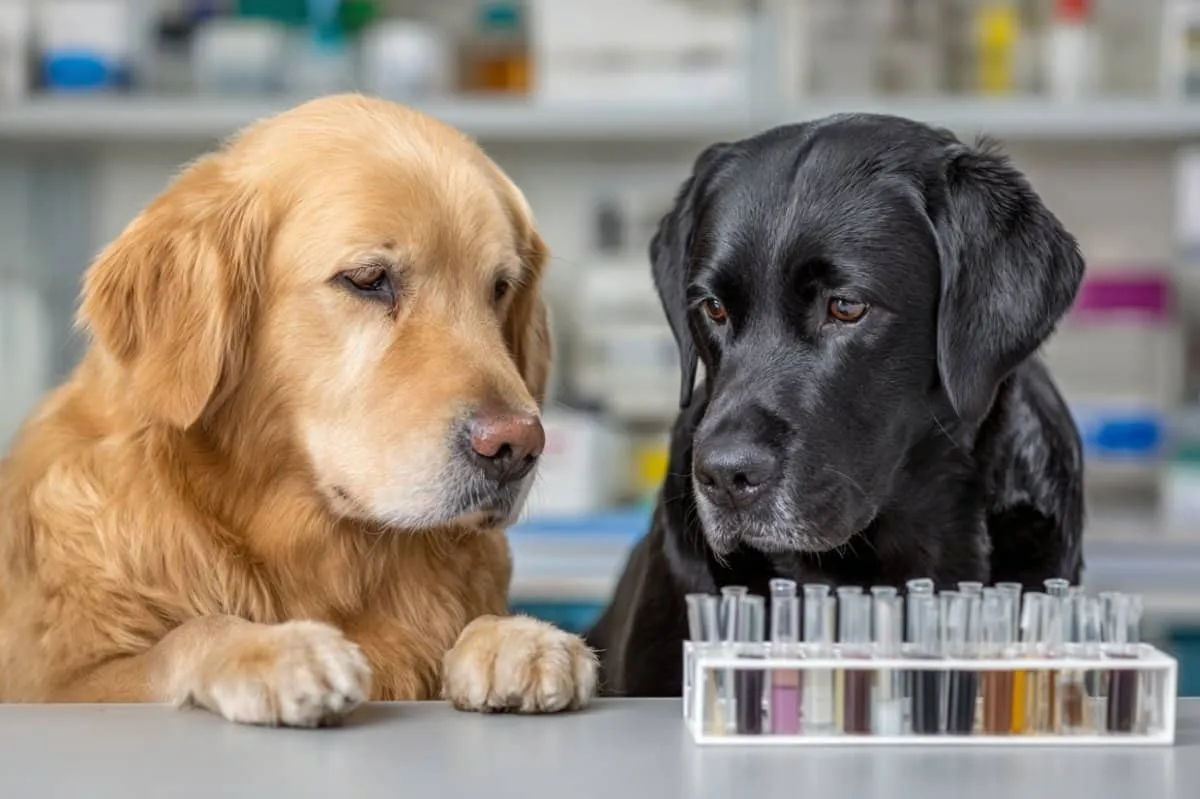
The two dogs in the study were a Golden Retriever, Bumper, and a Black Labrador, Peanut.
4155/v