Iranian Researchers Design Graphene-Based Nanocarrier for Gene Delivery
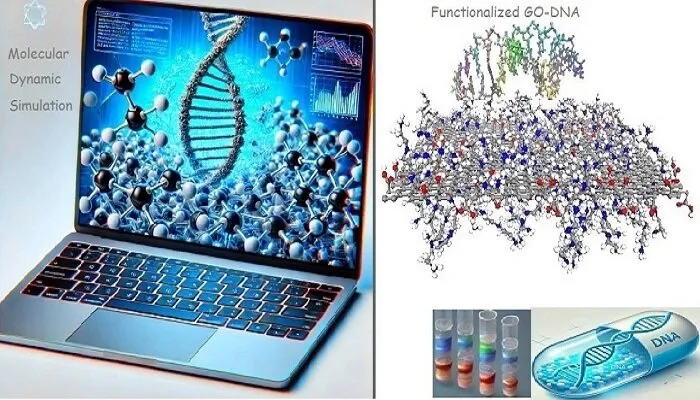
A research team at Amirkabir University of Technology has used molecular dynamics simulations to investigate, at the atomic level, how DNA interacts with a nanocarrier based on graphene oxide functionalized with cationic polymers.
The findings could provide a theoretical framework for developing next-generation non-viral gene delivery systems with improved efficiency, reduced toxicity and lower design costs.
The research, entitled "Investigation of the Interaction Between DNA Genes and Cationic Polymer-Functionalized Graphene Oxide Using Molecular Dynamics Simulation," was conducted by Samira Davoudinia under the supervision of Dr. Rana Imani and Dr. Mohammad Tafazoli, faculty members at the university, with Dr. Hesam Makki and Dr. Najmeh Fani serving as advisers.
Davoudinia, a graduate of Amirkabir University of Technology, described gene therapy as one of the most promising approaches developed in recent decades for treating genetic disorders, cancer and other difficult-to-treat diseases.
She explained that the approach relies on the targeted and efficient delivery of genetic materials, such as DNA or RNA, into specific cells, where they can promote the expression of beneficial genes or silence defective ones.
Despite early successes with viral delivery systems, concerns over immune responses, potential cancer risks and manufacturing complexity have encouraged researchers to explore non-viral alternatives.
However, challenges including nucleic acid degradation, carrier toxicity and limited intracellular delivery efficiency continue to restrict the performance of these systems.
Davoudinia noted that selecting and designing suitable carriers capable of protecting genetic material and delivering it effectively to target cells remains a major challenge in gene therapy. Nanocarrier engineering, she added, could play a crucial role in overcoming these limitations.
Designing a Graphene Oxide-Based Nanocarrier
The main objective of the study was to gain a deeper understanding of the molecular interactions between genetic material and advanced nanocarriers, which play a critical role in determining gene delivery mechanisms.
To achieve this, the researchers designed and modeled a nanocarrier based on graphene oxide functionalized with cationic polymers, with the aim of exploring its potential as an efficient non-viral gene delivery platform.
According to Davoudinia, the simulations enabled the team to examine interactions between DNA and the nanocarrier surface at the atomic level, identifying key mechanisms involved in genetic material adsorption, stabilization and release.
These molecular insights also helped clarify how the type and degree of surface functionalization influence nanocarrier performance.
The researcher emphasized that the simulation-based approach provides a more detailed understanding of how the chemical structure of cationic polymers and graphene oxide affects DNA behavior, creating opportunities for more targeted and optimized nanocarrier design.
The findings could therefore serve as a theoretical guide for developing gene delivery systems with higher efficiency and lower toxicity.
How Molecular Dynamics Simulations Were Used
The research employed molecular dynamics (MD) simulations to investigate interactions between genetic material and the proposed nanocarrier.
The primary objective was to analyze the molecular behavior of the system and understand the mechanisms governing gene adsorption, stabilization and release in the presence of cationic polymer-functionalized graphene oxide.
The researchers examined several key parameters influencing intermolecular interactions, including electrostatic, structural and dynamic interactions.
These analyses helped identify conditions that could optimize gene loading onto the nanocarrier and provided a framework for evaluating its performance and determining the factors that influence gene delivery efficiency.
The simulation results were subsequently used to optimize the nanocarrier's structural characteristics and propose more efficient designs for non-viral gene delivery systems.
Computational Challenges and Research Limitations
One of the main challenges encountered during the study involved preparing topology parameters and accurately structuring the components of the simulated system.
Developing stable and compatible topologies for interactions between the nanocarrier and DNA was particularly challenging, especially in the presence of different functional groups on the graphene oxide surface.
These factors introduced considerable computational and physical complexity. In some cases, manual adjustments and revisions to parameters and molecular structures were necessary to prevent instability during simulations.
Potential Applications in Gene Therapy and Nanomedicine
Davoudinia said the findings could have applications across several scientific and technological fields, particularly biomedical engineering, nanotechnology and gene delivery.
By focusing on the design and analysis of cationic polymer-functionalized graphene oxide nanocarriers, the study provides detailed insights into how genetic materials interact with nanostructured surfaces.
In biomedical technologies, these findings could support the development of a new generation of non-viral nanocarriers capable of delivering DNA and RNA more efficiently, with improved stability and reduced toxicity.
Such systems could have applications in treating genetic disorders and cancer, as well as developing innovative gene therapy approaches.
Industrial and Pharmaceutical Applications
The researcher also highlighted the potential industrial applications of the findings, particularly in the development of nanomedicine platforms, controlled drug release systems and biocompatible materials for clinical use.
In tissue engineering and regenerative medicine, the results could help optimize nanomaterial designs for targeted interactions with cells.
Furthermore, the molecular simulation approach could serve as a predictive tool for computationally designing nanocarriers before laboratory synthesis, potentially reducing the time and cost associated with developing advanced drug delivery technologies.
Findings Published in Nanoscale
Another important outcome of the research was the publication of a scientific paper in the journal Nanoscale, where it was also featured in the journal's Hot Article Collection.
Davoudinia identified the systematic analysis of molecular interactions between genetic material and the nanocarrier, alongside the evaluation and optimization of structural and chemical parameters affecting gene delivery efficiency, as the study's main innovations.
She noted that the research provides an atomic-level investigation of how the type and degree of polymer functionalization on graphene oxide influence DNA adsorption and stability through molecular dynamics simulations.
According to the researcher, the study not only presents a computational model for understanding the underlying interaction mechanisms but also establishes a potential design framework for developing optimized nanocarriers for gene therapy applications.
Next Steps: Experimental Validation
The next stages of the research will involve validating the simulation results through experimental studies, including in vitro tests and investigations in animal models, followed by in vivo evaluation.
Davoudinia emphasized that the atomic-scale molecular dynamics approach enables detailed analysis of interactions between nanocarriers and genetic materials.
She added that combining graphene oxide with cationic polymers creates a multifunctional platform with considerable flexibility in controlling gene loading and release.
The computational approach also offers an opportunity to reduce development time and costs compared with methods relying exclusively on experimental research.
Among the key advantages of the project is its ability to provide a detailed computational framework for predicting nanocarrier behavior before laboratory synthesis. This could reduce experimental costs, accelerate the design process and enable more targeted structural optimization.
The ability to analyze molecular interactions at the atomic level also represents a significant advantage over conventional experimental approaches.