From Isfahan to Manchester: Anita Memar’s search for a universal artistic language

Seyed Morteza Hosseini, Art Critic: In contemporary art, an artist is defined not only by technical ability or choice of medium, but by the capacity to develop a distinctive visual language, one that establishes a meaningful relationship between material, form, and thought.
Anita Memar's multidisciplinary practice reflects this approach. Working across ceramics, sculpture, painting, and mixed media, she has developed a body of work in which narrative unfolds through texture, silence, memory, and symbolic form rather than direct representation. Her works resist fixed interpretations, inviting viewers into an open process of reflection, emotional engagement, and personal discovery.
This conversation explores not only the evolution of Memar's artistic journey, but also the conceptual foundations of her practice. It examines the ideas that shape her work, her approach to material and narrative, and the critical position her practice occupies within contemporary art.
To begin, could you introduce yourself and tell us how your artistic journey first began?
I am Anita Memar, the artistic name of Mahshid Memarzadehesfahan, a multidisciplinary artist born in Isfahan in 1990. My fascination with art began in childhood. My mother had a deep passion for painting, embroidery, and traditional crafts, and our home was always filled with colour, texture, and the act of making. Long before I understood art consciously, I experienced it through materials, an early influence that continues to shape my practice today.

My professional journey began with illustration, but my artistic language has evolved through different disciplines. While studying Fashion Design at the University of Science and Culture, I became interested in the relationship between the body, form, texture, and structure, and in how objects can communicate emotion, identity, and narrative without words. This perspective continues to inform my sculptural practice.
Later, I completed an MA in Illustration at Manchester School of Art, Manchester Metropolitan University. Living and studying in the UK encouraged me to reconsider the relationship between narrative, material, space, and the viewer. I gradually realised that storytelling could not be confined to illustration alone, leading me towards sculpture, ceramics, painting, and mixed media, allowing each idea to determine its own visual language.
Today I work across sculpture, ceramics, painting, and mixed media. Storytelling remains central to my practice, although not through linear narratives. Instead, I explore questions of identity, memory, belonging, resilience, and transformation, allowing each artwork to become part of an ongoing dialogue between material, form, and lived experience.
The work of Alberto Giacometti has profoundly influenced my thinking, particularly his exploration of presence, solitude, and the human condition through the figure. More recently, I have drawn inspiration from Aliyah Hussain's poetic approach to materiality and layered narratives in ceramics. I am currently developing a new multidisciplinary body of work inspired by the poetry and philosophy of Jalal ad-Din Rumi, exploring silence, transformation, love, and inner renewal through sculpture, ceramics, painting, and mixed media.
"Isfahan", "art", and "Iran" what do these three concepts mean to you, and how have they influenced your artistic perspective?
For me, Isfahan is more than my birthplace; it is where my understanding of beauty, material, light, and narrative first developed. These three concepts, Isfahan, art, and Iran, are inseparable, forming the foundation of my visual memory.
Long before I consciously understood art, I lived within it. The city's architecture, traditional crafts, ceramics, textiles, calligraphy, and poetry shaped the way I observed the world. Only later did I realise that these were not simply childhood memories but the foundations of my visual language.
What I carry most strongly from Iranian culture is not its outward appearance, but its narrative sensibility. In Iranian literature, architecture, and art, meaning is rarely presented directly. It unfolds gradually through metaphor, symbolism, and contemplation. That approach continues to influence my work today. Rather than delivering a fixed message, I invite viewers to enter the work and uncover its narrative for themselves.
At the same time, I have never wanted my work to rely on obvious cultural symbols or become a direct representation of Iranian identity. My roots remain important, but they function as a point of departure rather than a destination. Living and working in the United Kingdom has made me even more aware that cultural identity reveals itself less through recognisable motifs than through the way we think, construct narratives, and engage with materials. Even when those origins are not immediately visible, I believe they continue to resonate throughout the work.
For international audiences, what aspects of Iranian artistic practice or modes of expression do you think are particularly distinctive? Do you see these qualities reflected in your own work?
I do not think it is possible to define all Iranian artists through a single characteristic. Iran has a rich and diverse cultural tradition, and every artist engages with that heritage differently.
What often resonates internationally is not simply Iranian imagery or cultural references, but a deeper narrative sensibility. Across Iranian literature, architecture, and visual culture, meaning is rarely presented directly. Instead, it unfolds through metaphor, symbolism, and layered interpretation, inviting viewers to participate in discovering it.
In my own practice, I have never wanted to represent "being Iranian" in a literal way. Instead, I try to transform cultural identity into a visual language that can be experienced more universally. My cultural background remains present in the way I think, construct narratives, and shape forms rather than through recognisable symbols or decorative motifs.
If audiences in Manchester, London, or elsewhere connect with my work, I hope it is not because they first recognise it as Iranian, but because it speaks to memory, emotion, and shared human experience. Ultimately, I believe the most enduring artworks emerge from authentic lived experience while remaining open enough to resonate across different cultures.
Womanhood and the female presence are recurring themes throughout your work, yet they are never confined to representations of Iranian or Eastern women. Instead, they point towards broader, more universal human experiences. How did this perspective develop?
In my view, the female figure is not the subject itself, but a visual language through which human experience can be explored. Although many of my figures are women, they are not intended to represent a particular person or cultural identity. Instead, they embody states such as silence, hope, resilience, vulnerability, and transformation, experiences that extend beyond geography and can be shared universally.
For that reason, my figures rarely possess a fixed identity. Rather than observing someone else's story, I want viewers to encounter emotions or situations in which they may recognise something of themselves.
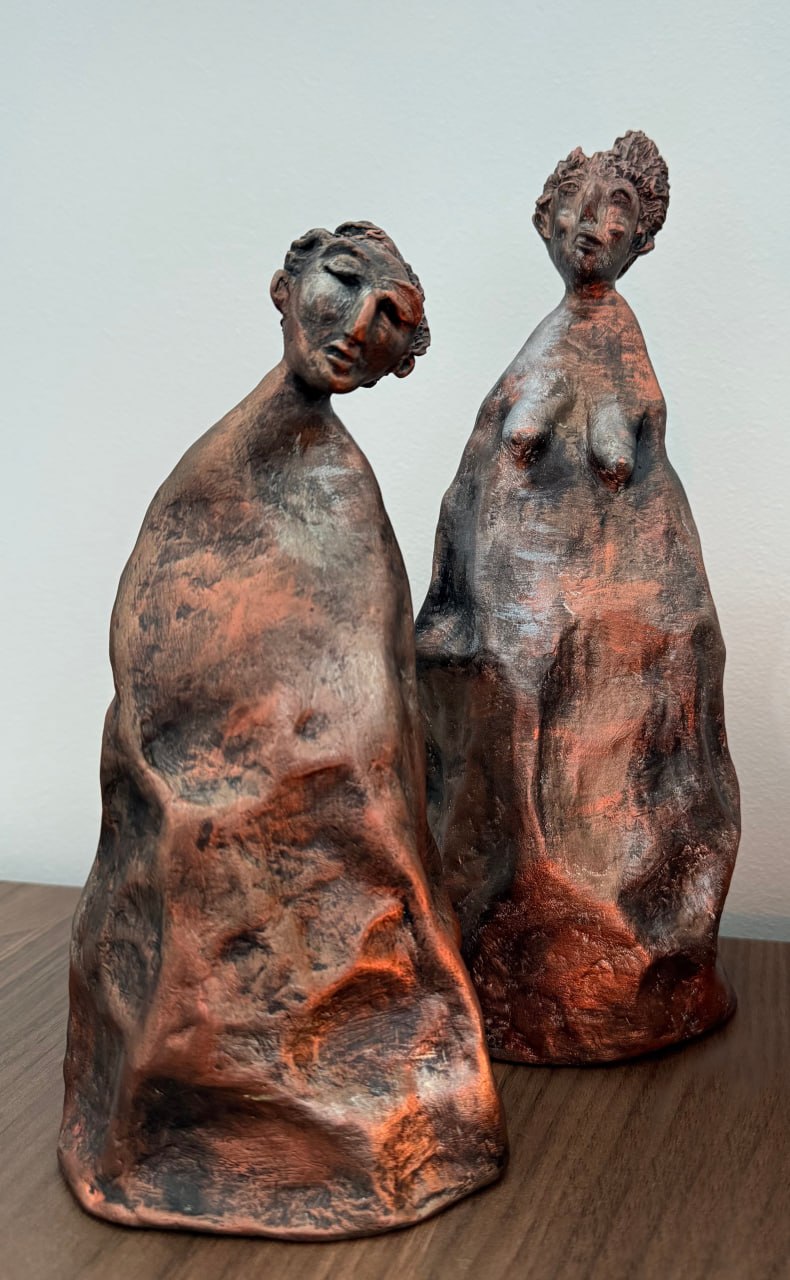
This approach is particularly evident in my Resilience in Silence series. The body is never simply a body; it becomes a narrative. Many sculptures rise gradually from a broad, grounded base towards an upright form, symbolising growth, endurance, and the possibility of renewal after hardship.
Material plays an equally important role. Layered textures, cracks, and subtle signs of erosion are never decorative; they evoke the traces of lived experience, allowing time, memory, and resilience to become visible within the work itself.
Although these figures appear quiet, I have never understood silence as weakness. For me, silence can contain hope, strength, and the determination to continue. Perhaps the deepest form of resilience lies not in dramatic gestures, but in the quiet ability to endure, remain present, and continue growing despite adversity.
What approach do you take to avoid the binary of tradition versus modernity? Do you see yourself as a contemporary artist detached from tradition, or do you still feel connected to the legacy of Iranian art?
have never felt the need to choose between tradition and contemporaneity. In my opinion, they are not opposing positions but two perspectives that can remain in constant dialogue.
What continues to inspire me about Iranian art is not its outward appearance, but the ways it shapes thought. Its richness lies in symbolism, layered meaning, and an invitation to contemplation. These qualities continue to influence my work, not through the repetition of traditional forms, but through their reinterpretation.
Living and working in the United Kingdom has introduced me to different artistic practices, exhibition contexts, and approaches to material and space. These experiences have expanded my visual language without diminishing my sense of identity.
I consider myself a contemporary artist, but being contemporary does not mean distancing myself from tradition. Rather, it means questioning inherited ideas and discovering new ways to reinterpret them. Contemporary practice is not simply about new materials or technologies; it is about remaining responsive to the present while remaining aware of the past.
If traces of Iranian culture remain visible in my work, they do so quietly through atmosphere, symbolism, and ways of seeing rather than through direct representation. I believe traditions remain alive only when they are allowed to evolve. I think that continuous dialogue between past and present is one of the defining characteristics of contemporary artistic practice.
In your recent series, particularly “Resilience in Silence” and “Shadow and Light”, the human figure gradually moves away from naturalistic representation towards abstraction and minimal form. In some works, the hands disappear entirely, while facial features are reduced to the bare minimum.
Does this deliberate reduction risk losing individuality and emotional expression? What led you to distance yourself from anatomical detail?
Yes, this was entirely intentional. The fewer descriptive details a figure contains, the more space it leaves for the viewer to connect with it. By removing recognisable identity, the figure no longer belongs to a particular individual, but becomes a vessel through which broader human experiences can be projected.
The absence of hands in my Resilience in Silence series was also a conscious decision. Hands often carry the narrative in figurative sculpture, expressing action and emotion. I wanted the story to emerge instead through the form itself.
For this reason, many of the figures begin with a broad, grounded base and gradually narrow as they rise, much like a mountain ascending towards its summit after a difficult climb. In my view, this structure becomes a metaphor for inner growth, resilience, and the journey towards light.
The layered textures reinforce this narrative. Rather than functioning as decoration, they evoke geological strata, erosion, time, and lived experience. The patinated surfaces further suggest endurance and the quiet dignity that develops through the passage of time.
Although these figures appear silent, they are never passive. Beneath that stillness lies hope, resilience, and the determination to continue. I have always believed that true strength is expressed not through dramatic gestures, but through the quiet ability to endure without losing one's inner vitality.
In your work, particularly in series such as “Silence in Resilience” and “Shadow and Light”, material is no longer simply a means of construction. Texture, colour, and surface seem to become part of the narrative itself. Is there a risk that viewers might become captivated by the physical qualities of the work before engaging with its underlying ideas? How do you balance visual aesthetics with emotional communication?
This is a question I continually ask myself throughout the making process. For me, aesthetic beauty is never an end in itself. If colour, texture, or surface become merely decorative, the work risks becoming an object of visual pleasure rather than a vessel for meaning.
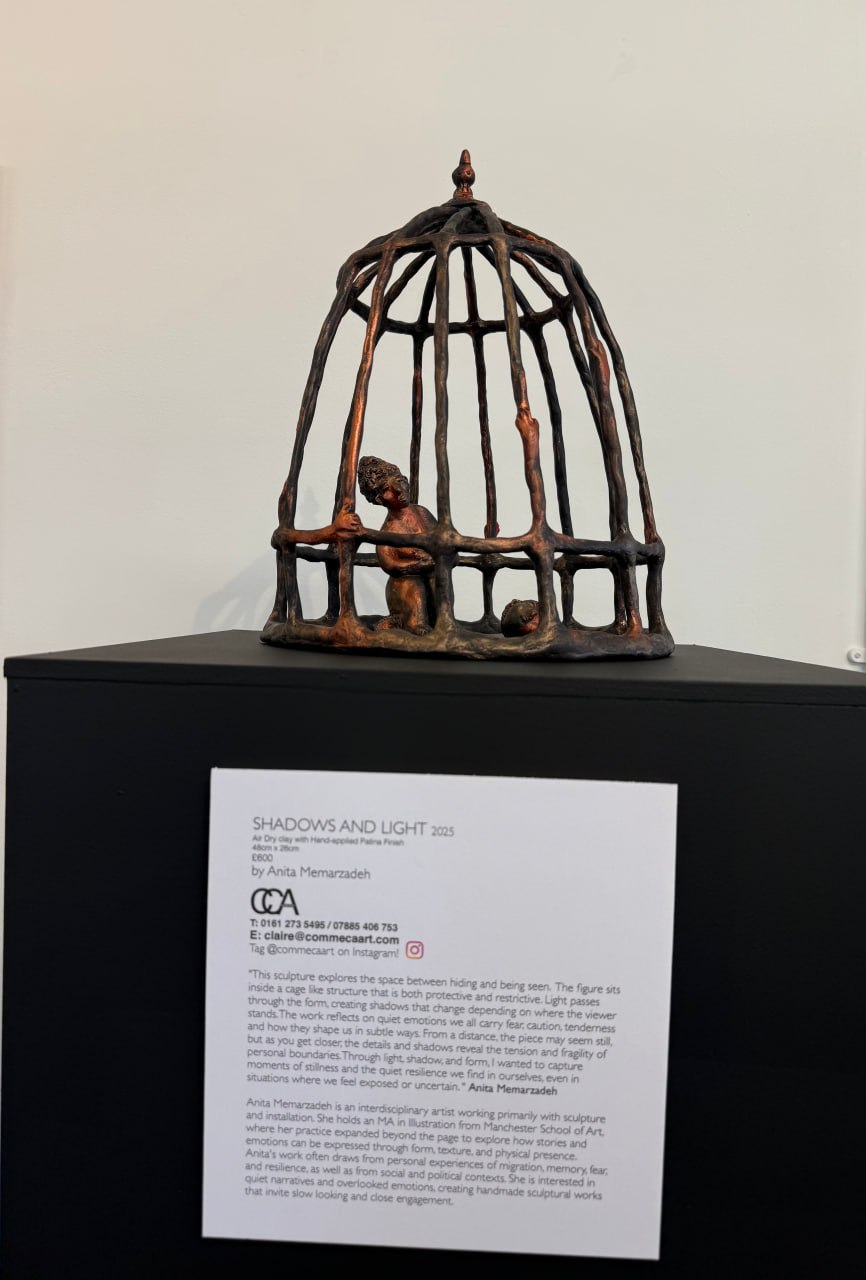
Every material decision in my practice carries conceptual significance. The layered textures across my sculptures are not ornamental; they evoke geological strata, the passage of time, accumulated experience, and the erosion that shapes both landscapes and human lives. Likewise, the patinated surfaces suggest endurance, silence, and resilience, giving the impression that the work has already lived before it reaches the viewer.
I believe visual attraction invites the audience into the work, but emotional depth encourages them to remain. Surface may capture attention, yet what ultimately matters is whether it leads to a deeper encounter.
This is especially true in works such as Shadow and Light. Viewers are often drawn first to the visual tension between stillness and instability, but I hope that initial encounter gradually opens onto something less tangible; an emotional or psychological experience that cannot be fully expressed through words. In my practice, the most meaningful works maintain a balance between beauty and vulnerability. Beauty draws the viewer in, while vulnerability invites them to construct their own emotional and personal reading of the work.
In your recent series, particularly “Behind the Shadow”, the closer viewers move towards the work, the fewer definitive answers they seem to find. Your narratives rely more on metaphor and silence than direct explanation. Do you feel that this level of ambiguity shifts part of the artist's responsibility for communication onto the audience?
I believe there is an important difference between ambiguity and openness. A work only succeeds when it offers viewers a point of entry, inviting them to bring their own experiences into the encounter.
I have never aimed to provide all the answers. Instead, I try to create space for reflection and participation. Every viewer approaches a work with different memories and emotions, so it is natural that each interpretation will be different.
In Behind the Shadow, this openness is intentional. The work is not meant to offer a single explanation of the human condition, but to reflect experiences that many people recognise in different ways. I deliberately avoid explaining every symbol because I want viewers to complete part of the narrative themselves.
I believe art becomes most powerful when it trusts its audience. Rather than imposing meaning, it creates the conditions for interpretation, allowing different readings to emerge through each individual's experience.
Ultimately, what matters is not whether viewers arrive at the same conclusion I had in mind, but whether the work continues to resonate after they leave. If it remains with them as something to reflect upon, then the dialogue between artwork and viewer has truly begun.
After moving abroad, your work has neither become nostalgic nor presented Iranian identity in an overt way. Some critics argue that many migrant artists, consciously or unconsciously, fall into the cliché of the “immigrant artist,” where migration itself becomes the central subject of their practice. Have you consciously distanced yourself from that path?
Absolutely. Migration inevitably changes a person's life, and it naturally reshapes an artist's perspective. However, I have never wanted migration itself to become the defining subject of my practice.
What interests me most is the universality of human experience. Migration is one experience that shapes us, but it can never fully define who we are.
The questions that concern me today are fundamentally the same as those that interested me before leaving Iran: identity, memory, silence, resilience, hope, and transformation. What has changed is not the subject itself, but the perspective from which I approach it. Living in another society made me realise that many emotions I once considered deeply personal or culturally specific are, in fact, shared across different cultures.
Perhaps that is why my work avoids overt cultural references. I do not want viewers to recognise my nationality before they encounter the work itself. I would rather they connect with the artwork first. If that experience later leads them to discover my cultural background, the conversation becomes far more meaningful.
One of the challenges faced by artists in diaspora is the expectation that their work should continually revolve around migration, politics, or national identity. I have consciously resisted that expectation because I believe an artist should remain free to pursue the questions that genuinely matter to them.
For me, migration was never a destination, but another way of seeing. It expanded my perspective without replacing my own visual language. Ultimately, my practice is not about migration itself, but about the human condition and an ongoing search for meaning, belonging, and hope beyond geographical and cultural boundaries.
You are currently developing a new body of work across painting, sculpture, and ceramics inspired by the poetry of Rumi. Yet your works do not directly illustrate his verses or well-known stories. How do you draw inspiration from literature without allowing the work to become merely illustrative?
Within my practice, Rumi is not an iconographic source but an intellectual and philosophical one. What attracts me is not his narratives or characters, but his reflections on transformation, silence, love, liberation, and the human condition. These are questions that have long existed within my own practice.
I have never wanted to translate poetry into images or create visual equivalents for literary texts. Doing so would limit both the poem and the artwork. Instead, literature functions as a catalyst, a starting point that stimulates an idea before allowing it to develop into an independent visual language.
This approach is reflected in a developing body of work inspired by Rumi, including Boundaries Within, Hidden Self, and Inner Light. Rather than illustrating specific poems, these works explore three interconnected stages of an inner journey, from confronting internal boundaries, to self-discovery, and ultimately to a sense of inner peace. Rumi's philosophy provides the conceptual foundation, while each work develops its own independent visual language.
For that reason, viewers do not need any knowledge of Persian literature to engage with my work. If they later discover those literary connections, they become an additional layer of meaning rather than a condition for understanding.
I believe literature truly enters the visual arts only when it stops being illustrated and begins to shape the way an artist thinks. I do not seek to depict Rumi; I seek to enter into a dialogue with his ideas. What emerges from that dialogue is not an illustration of a poem, but an autonomous work with its own visual language and independent life.
Throughout your practice, your works often appear as independent projects rather than chapters of a single continuous narrative. This independence allows each work to develop its own visual language, but it also raises an interesting question. If someone encounters only one piece, outside the context of the larger body of work, can it still stand on its own?
I have never regarded my practice as a collection of isolated works. Each piece grows from the one before it, developing questions that remain unresolved and continue to evolve. Rather than a sequence of separate objects, I see my practice as an ongoing conversation.
At the same time, every artwork must possess its own identity. I never want viewers to feel they need to understand an entire series before engaging with a single piece. Each work should be capable of creating its own emotional encounter and opening a dialogue on its own terms.
If someone later discovers the wider body of work, new relationships naturally emerge. I think of it much like reading individual chapters of a book. Each chapter is complete in itself, yet together they reveal a broader narrative.
For this reason, I see my projects less as fixed series than as an ongoing investigation. The central questions remain consistent, while the materials and visual language continue to evolve through sculpture, ceramics, painting, and mixed media.
Perhaps that is why I never feel a body of work is truly finished. Every piece resolves one stage of inquiry while opening another. Rather than producing definitive statements, I see my practice as an evolving constellation of interconnected conversations.
When you look back at your work ten years from now, what do you hope will still remain alive within it? More importantly, what kind of relationship would you like future audiences to have with your work?
I hope people remember my work not because of a recognisable style or a particular medium, but because of the sincerity that exists within it.
Styles evolve, techniques change, and every artist's perspective develops over time. What I hope remains constant is an honest commitment to the questions that continue to drive my practice.
When I look back ten years from now, I hope to feel that I remained true to myself despite the limitations and challenges of each stage of my life. Rather than repeating familiar solutions out of fear, I hope I will have continued searching, questioning, and allowing the work to evolve.
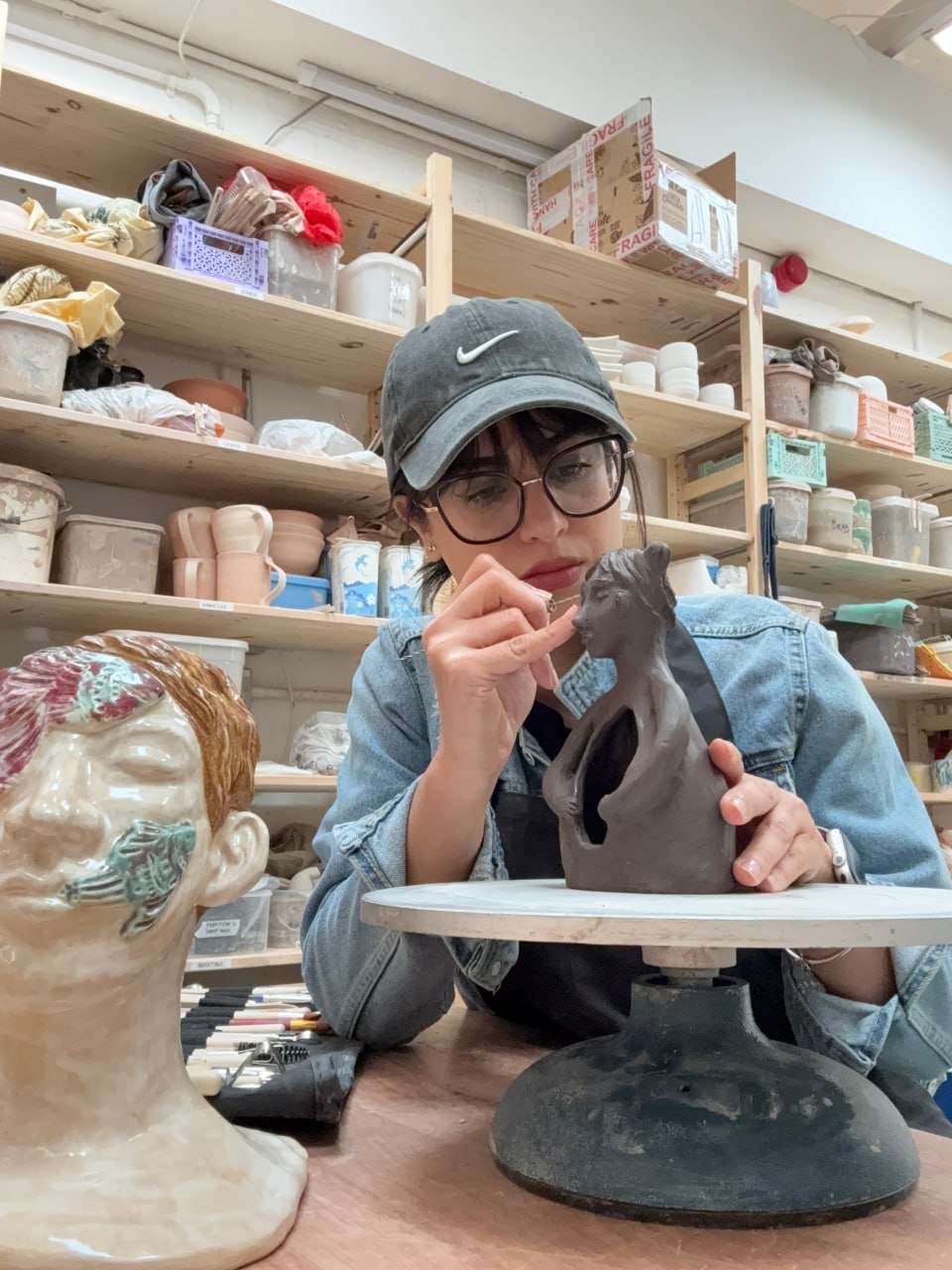
Artist Anita Memar in her Manchester studio, working on her multidisciplinary pieces
If someone encounters one of my artworks and, even for a brief moment, begins to see the world, or themselves, a little differently, then I feel the work has achieved something beyond simply existing as an object.
Ultimately, I believe art is more valuable as an invitation than as a definitive answer. It invites us to look, reflect, and question. If my work can keep that invitation alive, even many years from now, I will feel that I have remained true to my path as an artist.
Review: Anita Memar's practice is defined by an ongoing investigation into the relationship between material, memory, and human experience. Working across sculpture, ceramics, painting, and mixed media, she moves beyond the illustrative function of narrative, using form, texture, and spatial relationships as vehicles for emotional and conceptual enquiry. Rather than presenting fixed meanings, her work encourages an open encounter in which interpretation unfolds gradually through the viewer's engagement.
A recurring characteristic of Memar's practice is her rejection of explicit symbolism. While her work is informed by her Iranian cultural background, it does not rely on recognisable cultural motifs or ethnographic references. Instead, identity is embedded more subtly through material sensibility, narrative structure, and an attentiveness to silence, transformation, and the passage of time.
In doing so, her practice avoids reducing cultural identity to visual ornament, positioning it instead as an underlying way of seeing and constructing meaning.
Works such as Behind the Shadow, Shadow and Light, and Resilience in Silence demonstrate a sustained exploration of how intangible emotional states can be translated into physical form.
The gradual reduction of figurative detail, the restrained use of symbolic language, and the dialogue between surface, texture, and volume suggest an artistic practice that privileges contemplation over representation. It is precisely this formal restraint that gives the work its critical strength, allowing emotional meaning to emerge through material rather than explicit narrative. Material is never treated as a passive medium; it functions as an active component of the work's conceptual structure.
Equally significant is Memar's understanding of the relationship between artwork and audience. Throughout her practice, meaning is not presented as a fixed conclusion but remains intentionally open. Rather than directing interpretation, she constructs spaces in which viewers actively participate in the production of meaning through their own memories and experiences. This approach aligns her work with contemporary artistic practices that prioritise dialogue over declaration and experience over explanation.
Perhaps the most distinctive aspect of Memar's practice is its commitment to continuity rather than resolution. Individual works function autonomously, yet they also form part of a broader investigation that evolves across different materials and bodies of work. Questions surrounding identity, belonging, resilience, silence, and transformation are continually revisited from new perspectives, allowing the practice to develop organically without repeating itself.
Ultimately, Memar's work resists both cultural simplification and formal certainty. Rather than presenting fixed conclusions, it proposes an artistic language in which material, memory, and human experience remain in continuous dialogue. In doing so, her practice occupies a thoughtful position within contemporary art, privileging inquiry over certainty and inviting viewers into an active process of interpretation rather than passive observation.