New Study Claims: Dark Matter, Dark Energy Don’t Exist
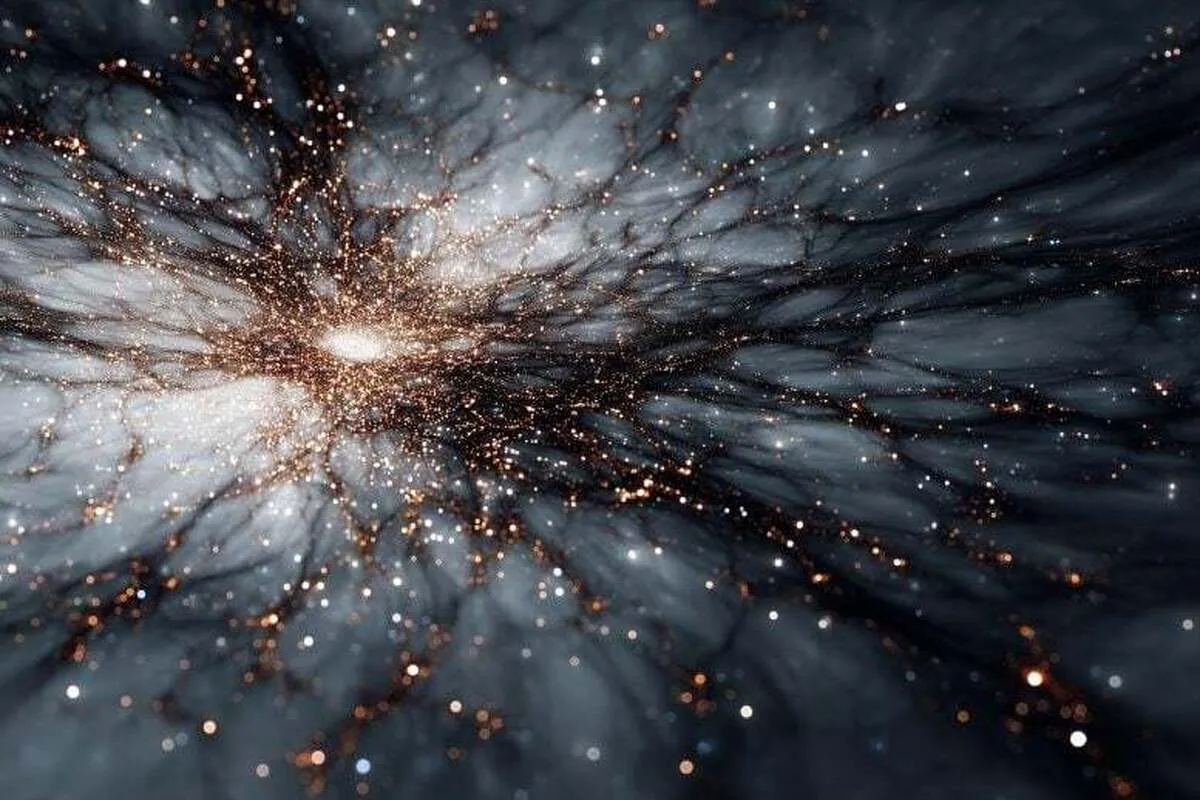
For many years, scientists have thought that dark matter and dark energy make up most of the cosmos. A new study, however, challenges that long-held belief by proposing that these mysterious components might not exist at all. Instead, what appears to be dark matter and dark energy could actually result from the gradual weakening of the universe’s fundamental forces as it grows older, the journal Galaxies reported.
The research, led by Rajendra Gupta, an Adjunct Professor in the Department of Physics at the University of Ottawa, suggests that if the core strengths of nature’s forces (like gravity) change slowly across time and space, they could account for the puzzling behaviors astronomers see—such as how galaxies rotate, evolve, and how the universe continues to expand.
“The universe’s forces actually get weaker on the average as it expands,” Professor Gupta explains. “This weakening makes it look like there’s a mysterious push making the universe expand faster (which is identified as dark energy). However, at galactic and galaxy-cluster scale, the variation of these forces over their gravitationally bound space results in extra gravity (which is considered due to dark matter). But those things might just be illusions, emergent from the evolving constants defining the strength of the forces.”
He adds, “There are two very different phenomena needed to be explained by dark matter and dark energy: The first is at cosmological scale, that is, at a scale larger than 600 million light years, assuming the universe is homogeneous and the same in all directions. The second is at astrophysical scale, that is, at smaller scale the universe is very lumpy and direction dependent. In the standard model, the two scenarios require different equations to explain observations using dark matter and dark energy. Ours is the only one that explains them with the same equation, and without needing dark matter or dark energy.”
He adds, “What’s really exciting is that this new approach lets us explain what we see in the sky: galaxy rotation, galaxy clustering, and even the way light bends around massive objects, without having to imagine there’s something hiding out there. It’s all just the result of the constants of nature varying as the universe ages and becomes lumpy.”
Last year, Professor Gupta challenged the existence of dark matter in the universe in his cosmological-scale study. In this astrophysical-scale work, he questioned the current theoretical models for the galaxy rotation curves.
In the new model, the parameter often denoted α emerges from allowing the coupling constants to evolve. In effect, α behaves like an extra “component” in the gravitational equations that produces effects similar to what astronomers attribute to dark matter and dark energy.
On cosmological scales, α is treated as a constant (e.g., determined by fitting supernovae data). But locally (on astrophysical scale), in a galaxy, because the standard matter (black holes, stars, planets, gas, etc.) distribution varies drastically, α varies, causing the extra gravitational effect to depend on where such matter is. So the new theory predicts that in regions where there’s a lot of standard matter, the extra gravity effect is less, and where detectable matter density is low, it is larger.
In effect, instead of adding dark matter halos around galaxies, the extra gravitational pull comes from α in the new model. It reproduces the observed “flat rotation curves” (stars moving faster than expected in the outer parts of galaxies).
Professor Gupta believes this idea could solve some of the biggest puzzles in astronomy. “For years, we’ve struggled to explain how galaxies in the early universe formed so quickly and became so massive,” he says. “With our model, you don’t need to assume any exotic particles or break the rules of physics. The timeline of the universe simply stretches out, almost doubling the universe’s age, and making room for everything we observe.”
Effectively, the stretched-out timeline for how stars and galaxies form, makes it much easier to explain how big, complex structures like galaxies and black holes could have appeared so early in the universe.
This theory could completely change how we think about the universe. It even hints that searching for dark matter particles, something scientists have spent years and billions of dollars on, might not be necessary after all. Even if the exotic particles are experimentally found they would need to constitute about six times the mass of the standard matter.
“Sometimes, the simplest explanation is the best one. Maybe the universe’s biggest secrets are just tricks played by the evolving constants of nature,” Professor Gupta concludes.
4155/v


















