New Tech Uses Twisted Light to Reveal Hidden Images
Using carefully arranged nano-structures, this technology doesn’t just trick the eye—it opens doors to next-gen encryption, biosensing, and quantum tech. From invisible watermarks to detecting drug purity, this flat device uses the fundamental physics of “handedness” to unlock secrets nature and science have long kept hidden, the journal Nature Communications reported.
Trying to put a left-handed glove on your right hand doesn’t work because the two are mirror images—they look similar but don’t align. This concept, known as “chirality,” is a key principle in biology, chemistry, and materials science. In nature, most DNA strands and sugars are right-handed, while most amino acids are left-handed. If a molecule’s handedness is flipped, it can stop functioning correctly. A nutrient may become ineffective, or a medication might lose its benefits or even become dangerous.
Light, too, can have a kind of handedness. When light is circularly polarized, its electric field rotates as it moves forward, forming either a left-handed or right-handed spiral. Chiral materials respond differently to each type of polarized light. By shining circularly polarized light on a substance and measuring how each spiral is absorbed, reflected, or delayed, scientists can learn about the material’s own chirality. But because these interactions are extremely subtle, controlling chirality with precision has been a long-standing challenge.
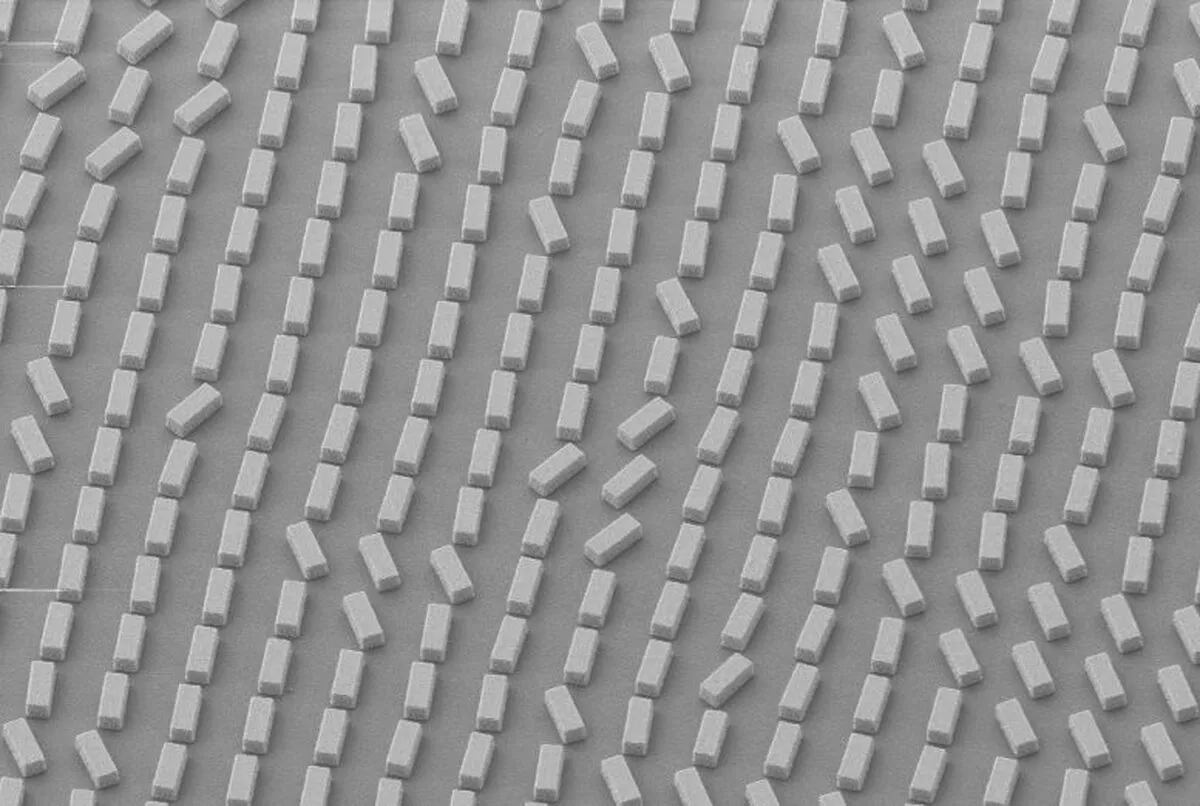
Now, scientists from the Bionanophotonic Systems Laboratory in EPFL’s School of Engineering have collaborated with those in Australia to create artificial optical structures called metasurfaces: 2D lattices composed of tiny elements (meta-atoms) that can easily tune their chiral properties. By varying the orientation of meta-atoms within a lattice, scientists can control the resulting metasurface’s interaction with polarized light.
“Our ‘chiral design toolkit’ is elegantly simple, and yet more powerful than previous approaches, which tried to control light through very complex meta-atom geometries. Instead, we leverage the interplay between the shape of the meta-atom and the symmetry of the metasurface lattice,” explains Bionanophotonics Lab head Hatice Altug.
The innovation, which has potential applications in data encryption, biosensing, and quantum technologies, has been published in Nature Communications.
The team’s metasurface, made of germanium and calcium difloride, presents a gradient of meta-atoms with orientations that vary continuously along a chip. The shape and angles of these meta-atoms, as well as the lattice symmetry, all work together to tune the response of the metasurface to polarized light.
In a proof-of-concept experiment, the scientists encoded two different images simultaneously on a metasurface optimized for the invisible mid-infrared range of the electromagnetic spectrum. For the first image of an Australian cockatoo, the image data were encoded in the size of the meta-atoms – which represented pixels – and decoded with unpolarized light. The second image was encoded using the orientation of the meta-atoms so that, when exposed to circularly polarized light, the metasurface revealed a picture of the iconic Swiss Matterhorn.
“This experiment showcased our technique’s ability to produce a dual-layer ‘watermark’ invisible to the human eye, paving the way for advanced anticounterfeiting, camouflage, and security applications,” says Bionanophotonics Systems Lab researcher Ivan Sinev.
Beyond encryption, the team’s approach has potential applications for quantum technologies, many of which rely on polarized light to perform computations. The ability to map chiral responses across large surfaces could also streamline biosensing.
“We can use chiral metastructures like ours to sense, for example, drug composition or purity from small-volume samples. Nature is chiral, and the ability to distinguish between left- and right-handed molecules is essential, as it could make the difference between a medicine and a toxin,” says Bionanophotonic Systems Lab researcher Felix Richter.
4155/v