Agrivoltaics could reduce water and electricity consumption in agriculture
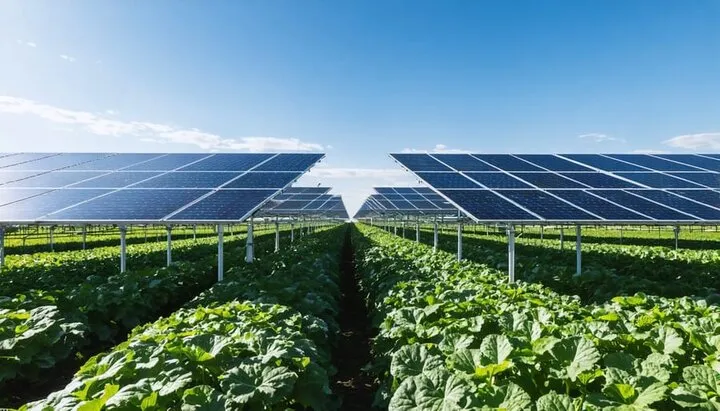
Researchers at the University of California, Davis, are investigating whether carefully designed solar panel layouts can also reduce the amount of water needed for agricultural crops.
The approach, known as agrivoltaics or solar farming, involves using agricultural land for both crop cultivation and solar energy generation, rather than dedicating it exclusively to either purpose. Under this system, sunlight is shared between plants and electricity-generating equipment.
The concept is gaining attention as agricultural regions face hotter summers, mounting pressure on water resources and growing demand for clean energy. However, shade is not always beneficial to plants, which still require sufficient sunlight to grow and produce optimal yields.
Soil scientist Majdi Abou Najm and his colleagues at UC Davis are studying tomato plants grown beneath several different solar panel configurations. Their goal is to identify designs that provide beneficial shade without significantly reducing crop production.
At the research site, four different solar panel designs are being compared under similar soil and weather conditions. In one configuration, panels are installed vertically and can capture sunlight from both sides. As the sun moves across the sky, the panels cast shifting shadows across the ground.
Other systems use panels that track the sun throughout the day, while another design features red-tinted panels that allow some of the light needed for photosynthesis to pass through while absorbing other wavelengths to generate electricity.
The researchers are also examining how plants respond to different irrigation levels. One tomato field receives the standard amount of water required by the crop, while an adjacent field receives only half that amount.
The research team measures how much water is absorbed from the soil by plants and ultimately released into the atmosphere through them. These measurements help researchers determine crop water requirements and assess whether shading can change the amount of water needed for irrigation.
Traditional estimates of crop water requirements are often based on the assumption that plants grow under full sunlight. These calculations may be less accurate in conditions where solar panels alter temperature, shade and airflow around crops.
The three-year research project will examine both summer and winter crops. Researchers hope its findings will provide more precise guidelines for determining the water requirements of fields beneath different solar panel configurations.
The potential benefits of this approach are considerable. Solar panels can generate electricity or provide an additional source of income while protecting crops from intense sunlight. Reducing plants’ water requirements could also be particularly valuable during droughts.
However, the research is still ongoing, and it is too early to conclude that all solar panel configurations will reduce water consumption or increase crop yields. Outcomes may depend on crop type, regional climate, panel height and installation costs.
Agrivoltaics also raises practical questions about machinery access and farm management around solar equipment. These factors, alongside scientific measurements, are important for evaluating the method’s overall effectiveness.
According to Norwich, the UC Davis experiments aim to identify the conditions under which combining agriculture and solar energy generation is most efficient. If successful, the approach could allow farmland to contribute simultaneously to food production, renewable energy generation and greater agricultural resilience to climate change.