NASA’s Satellite Uncovers 100,000 Hidden Mountains beneath Ocean
These new maps uncover tens of thousands of unknown underwater mountains and hills that shape deep-sea ecosystems and offer clues to Earth’s geologic past. With this breakthrough, scientists are rapidly closing in on a full map of the ocean bottom, decades ahead of what sonar mapping alone could accomplish, the SciTechDaily reported.
We have more detailed maps of the Moon’s surface than we do of Earth’s ocean floor. For decades, scientists have been working to change that. Now, a NASA-supported research team has taken a major step forward by creating one of the most detailed maps of the seafloor to date, using data from the SWOT (Surface Water and Ocean Topography) satellite.
Mapping the ocean floor accurately is essential for many reasons: from safe navigation and laying underwater communication cables to understanding deep-sea currents, tides, and geological activity like plate tectonics. Seafloor features such as underwater mountains (seamounts) and smaller formations known as abyssal hills help shape how heat and nutrients move through the deep ocean, creating conditions that can support marine life.
Although ships equipped with sonar can capture highly detailed images of the seafloor, only about 25 percent of the ocean has been mapped this way. To build a more complete picture, researchers have increasingly turned to satellites.
Because geologic features like seamounts and abyssal hills have more mass than their surroundings, they exert a slightly stronger gravitational pull that creates small, measurable bumps in the sea surface above them. These subtle gravity signatures help researchers predict the kind of seafloor feature that produced them.
SWOT, a collaboration between NASA and the French space agency CNES (Centre National d’Études Spatiales), covers about 90 percent of the globe every 21 days. Through repeated observations, the satellite is sensitive enough to pick up these minute differences, with centimeter-level accuracy, in sea surface height caused by the features below. David Sandwell, a geophysicist at Scripps Institution of Oceanography, and his colleagues used a year’s worth of SWOT data to focus on seamounts, abyssal hills, and underwater continental margins, where continental crust meets oceanic crust.
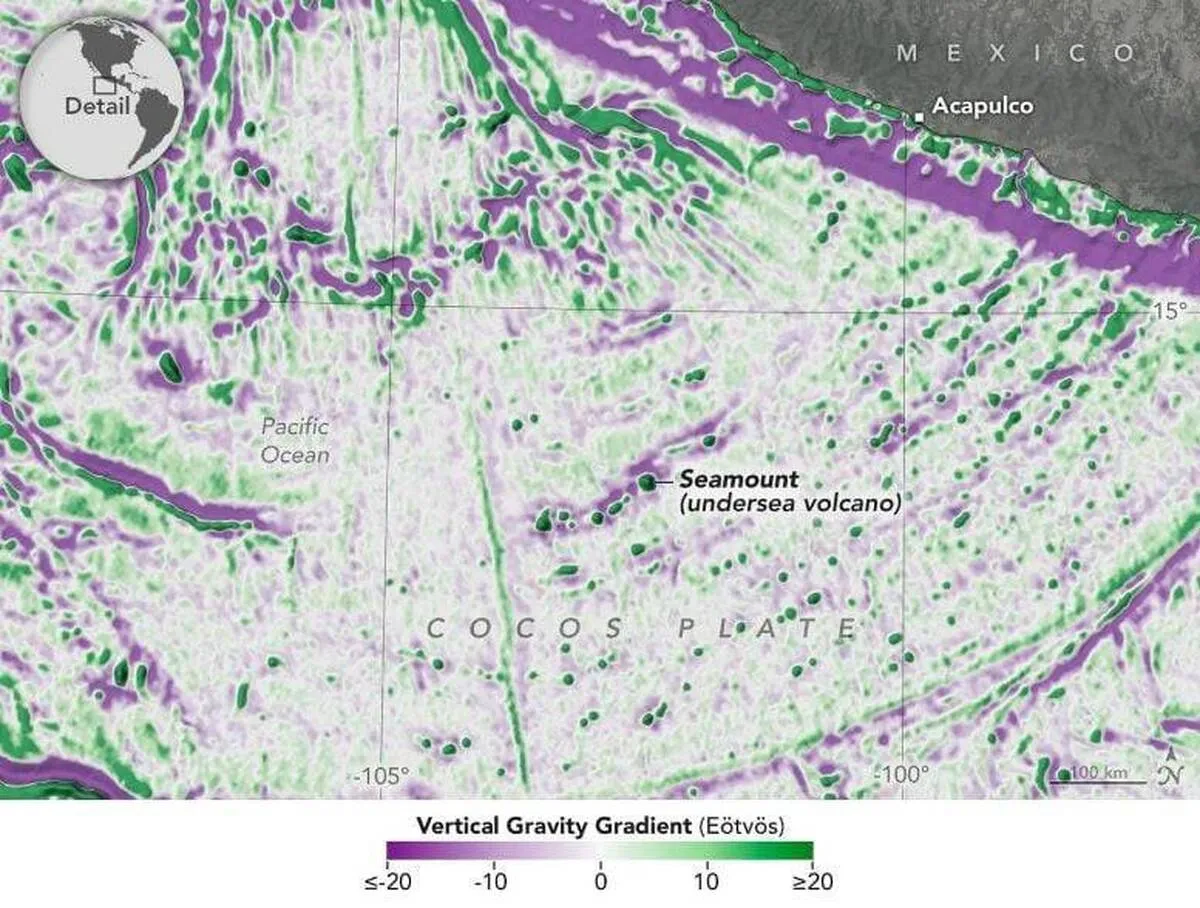
The results of their mapping effort are visible on the global map (top) and the detailed views above and below. Areas of decreased gravity (purple) are affiliated with depressions on the seafloor, while areas of increased gravity (green) indicate the locations of more massive, elevated features.
Previous ocean-observing satellites have detected massive versions of these bottom features, such as seamounts over roughly 1 kilometer (3,300 feet) tall. The SWOT satellite can pick up seamounts less than half that height, potentially increasing the number of known seamounts from 44,000 to 100,000. These underwater mountains stick up into the water, influencing deep sea currents. This can concentrate nutrients along their slopes, attracting organisms and creating oases on what would otherwise be barren patches of seafloor.
“The SWOT satellite was a huge jump in our ability to map the seafloor,” Sandwell said. Sandwell has used satellite data to chart the bottom of the ocean since the 1990s and was one of the researchers responsible for the SWOT-based seafloor map, which was published in the journal Science in December 2024.
The improved view from SWOT also gives researchers more insight into the geologic history of the planet.
“Abyssal hills are the most abundant landform on Earth, covering about 70 percent of the ocean floor,” said Yao Yu, an oceanographer at Scripps Institution of Oceanography and lead author on the paper. “These hills are only a few kilometers wide, which makes them hard to observe from space. We were surprised that SWOT could see them so well.”
Abyssal hills form in parallel bands, like the ridges on a washboard, where tectonic plates spread apart. The orientation and extent of the bands can reveal how tectonic plates have moved over time. Abyssal hills also interact with tides and deep ocean currents in ways that researchers don’t fully understand yet.
The researchers have extracted nearly all the information on seafloor features they expect to find in the SWOT measurements. Now they’re focusing on refining their picture of the ocean floor by calculating the depth of the features they see. The work complements an effort by the international scientific community to map the entire seafloor using ship-based sonar by 2030. “We won’t get the full ship-based mapping done by then,” Sandwell said. “But SWOT will help us fill it in, getting us close to achieving the 2030 objective.”
4155/v